
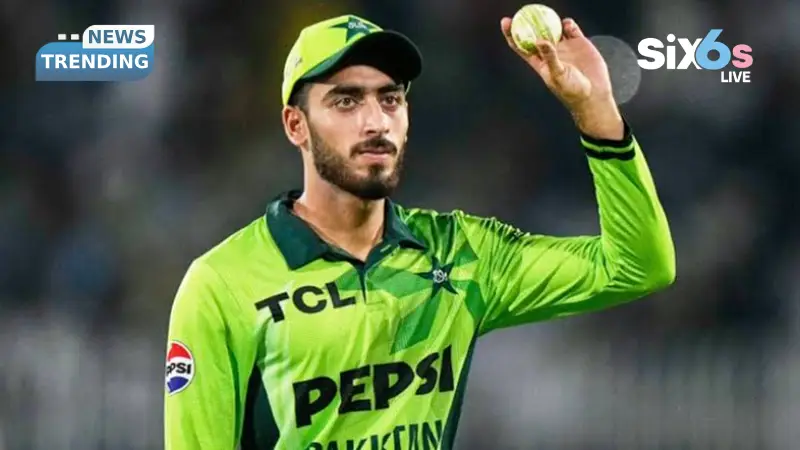
Arafat Minhas settled the number seven debate in Rawalpindi on 20 October with bat and ball in the same match. A 58-ball 59 and figures of 6 for 40 carried Pakistan to an 87-run win over England, and the match award was never in doubt. A side that had been rotating options in the lower middle order now has a candidate who delivers in two departments. What that means for Shadab Khan and the balance of the XI is the real question.
A Complete Display From the Lower Order
Pakistan reached 302 for 9, and Minhas supplied 59 off 58 deliveries from the seventh spot, steadying an innings that needed a calm head after the top order had done its work. England were then dismissed for 215, with his 6 for 40 across 8.4 overs doing the bulk of the damage. The margin of 87 runs reflects how decisive the contribution was, not how decorative it looked on the scorecard. Few seventh-slot players get to shape both halves of a game so completely, and that is why the performance carries weight beyond one result.
The position matters as much as the numbers. He walked in at seven against Sri Lanka on 18 October and again two days later, which tells you the management sees this as a defined job and not a passing experiment. Both games finished as wins, by 37 runs and then 87, so Pakistan sit on 4 points from 2 matches with the role producing results. Stability is an edge here.
Arafat Minhas Pakistan Tri Series 2026 Number Seven
Shadab Khan is the obvious casualty of this rise. He was ill before the Sri Lanka game and did not feature against England, so the XI that beat England had no place for him at all. A spinner with more than 70 ODIs and over 80 wickets, and an economy of 5.24, was not missed because Minhas produced a cheaper return, with an economy of 4.96. Pakistan did not lose any bowling control by leaving the senior spinner out, and that detail will shape the next team sheet.
Selection logic now runs differently. Shadab’s value has always come from the combination of leg-spin and lower-order hitting, and Minhas offers both traits in a package that suits an attack already built around four quicks. If Shadab returns fit, the management must decide whether to rebuild the bowling around spin or protect a pairing that is already winning. Neither option is free of risk, and the answer will tell us how much faith the dressing room places in one standout evening versus a long-established name.
Salman Agha and the Shifting Middle Order
The other piece of the puzzle is Salman Agha, who moved between fifth and sixth in the two games while Hasan Nawaz swapped places with him. Salman carries 23 ODIs, an average of 39.42 and a strike rate of 100.93, plus an economy of 5.56 and four wickets. That is a useful all-round package, but it points to a middle-order finisher more than a seventh-slot bowler.
The top four of Fakhar, Ayub, Babar and Baig stayed identical across both matches, and the attack of Faheem, Shaheen, Naseem and Rauf did too. With that core fixed, the only moving parts are the middle-order shuffle and the spinner’s slot. Minhas fills the space between them as a batter who can bowl serious overs, which gives the captain a sixth bowling option without weakening the batting depth.
Lahore Will Test the Experiment
Pakistan return to Lahore for England on 25 October and Sri Lanka on 27 October, and both games sit before the final on 31 October, where only the top two teams qualify. Small adjustments in selection will matter in a short table. One poor day with the bat or ball could turn a celebrated breakthrough into a debated gamble.
The numbers make the case for continuity for now. Whatever happens next, the debate around Arafat Minhas Pakistan tri-series 2026 number seven starts from a position of strength, and Pakistan should keep the order that has won two from two. If the form holds in Lahore, the question will stop being whether he deserves the slot and become who else deserves to share it.