
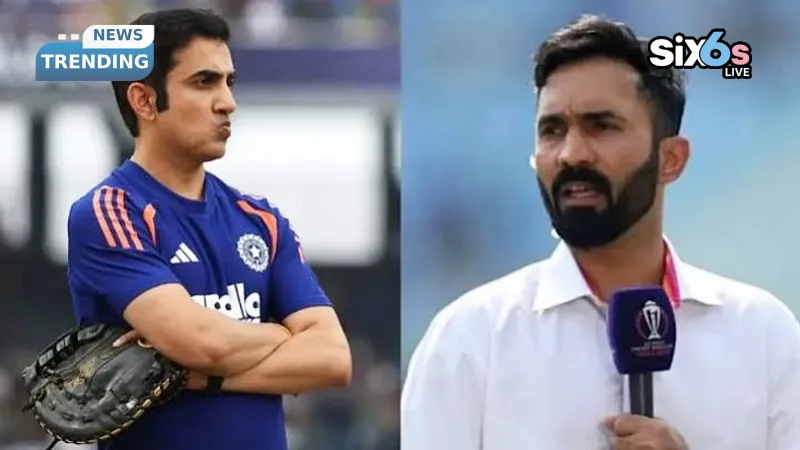
Gambhir’s team sent Harshit Rana in at No. 7 ahead of Shivam Dube during India’s chase of 202, with the innings reduced to 52 for 5 inside the powerplay. Rana lasted 13 balls for nine runs before Dube managed just two from four, and India folded for 76, their heaviest T20I defeat by runs. Dinesh Karthik, working the game as a broadcaster, questioned the move live on air, and the clip spread quickly once the game ended, reviving old questions about the batting order under pressure.
Rana’s Promotion That Changed the Chase
India were chasing 202 in Nottingham when the innings unraveled inside the powerplay. Axar Patel fell on the final ball of the fifth over with the score at 52 for 5, and the team sent Harshit Rana in next instead of Shivam Dube.
Rana made nine off 13 balls before he was caught at deep third off Josh Tongue. Dube followed at No. 8 and managed only two from four deliveries, beaten for pace by the same bowler. India were bowled out for 76 in 11.4 overs, a 125-run defeat that stands as their heaviest by runs in T20I history, surpassing an 80-run loss to New Zealand in Wellington back in 2019.
Gautam Gambhir Dinesh Karthik T20I 2026 criticism
Karthik, working in the commentary box for the series, questioned the move the moment Rana walked out. He said he did not think Rana had ever batted in the powerplay before, even in domestic cricket, and struggled to understand why a bowling specialist was preferred over a recognised hitter at that stage.
He acknowledged that a left-right combination can work in T20 cricket, but argued it only holds up to a point, and that sending a bowler ahead of a genuine finisher crossed that line. He also wondered aloud whether the team management simply did not trust Dube enough at that point of the chase.
By the time the game ended, he summed up the wider mood around the innings as one with more questions than answers, both for the team as a whole and for individual players still finding their feet in the format.
The Left-Right Logic That Fell Apart
The reasoning behind sending Rana ahead of Dube was built around a left-right batting combination, aimed at disrupting the lines England’s quicks had been bowling to left-handers all series. On paper, pairing a right-hander with the recognised power-hitter made sense against Archer and Tongue.
In practice, it meant a bowler with almost no batting pedigree walked out during the exact phase India needed a genuine hitter. The theory held up in a spreadsheet, but it collapsed the moment Rana had to face fast bowling with the score already unraveling.
Other voices echoed the same doubt after the match. Parthiv Patel went further, calling the top order unworkable given how many left-handers sat inside it, and argued Sanju Samson should have come in for Dube by the time the series reached Bristol.
India’s Management Faces the Fallout
Gambhir never directly addressed the Rana-for-Dube call in his press conference. Instead, he leaned on a broader defence, pointing to how much the T20 squad had changed since the World Cup final and describing the results as part of a reset that takes time to settle.
He pointed to the inexperience across the group, a teenage opener, a bowler just back from injury, a player with only two caps, and said practicality mattered as much as results while a young side found its feet. On Samson’s continued absence, he insisted there was no rule against a recall once form allowed it.
Shreyas Iyer was blunter, calling the batting display atrocious and admitting the margin of defeat was impossible to accept. He pointed to losing four wickets inside the powerplay as the moment that killed any real momentum in the chase, and conceded execution had been well below standard all series.
With Iyer without a win in four games as T20I captain, the defeat extended India’s losing run to four matches in a row. None of it settles the specific question that triggered Gautam Gambhir and Dinesh Karthik’s T20I 2026 criticism in the first place: why a bowler batted ahead of a hitter when the chase needed exactly the opposite.