
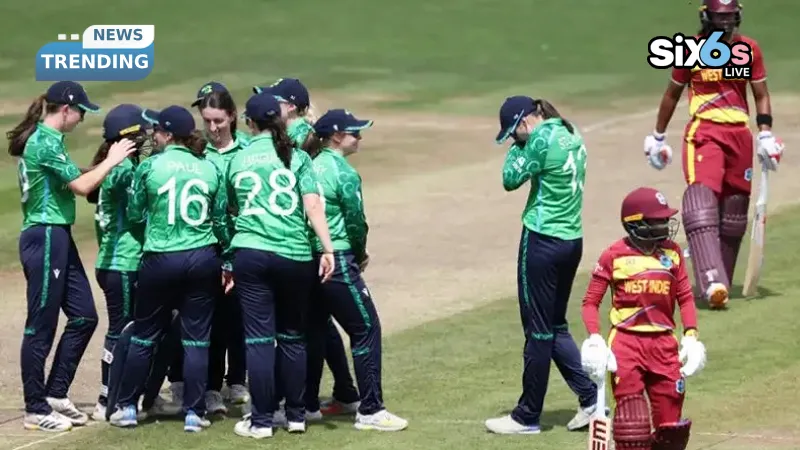
Ireland Women beat West Indies by six wickets in Bristol on June 27, 2026, ending an 0-21 losing run across five Women’s T20 World Cup tournaments that had stretched over 12 years. Less than 24 hours earlier, Ireland Men had beaten India in Belfast for the first time ever in T20I history. The two results arrived in sequence across roughly one day, and together they represent something Irish cricket had never experienced before: both senior programmes delivering historic firsts at the same moment.
The Match That Ended a 21-Game Losing Run
West Indies posted 128/7 from their 20 overs. Ireland’s bowlers had been sharp in the final phase, and Aimee Maguire finished with figures of 4-0-22-2 as Ireland restricted the total to something chaseable. At 88/1 after 12.6 overs, the chase was well set. The second wicket fell at that point and two more followed before the target was reached, but Ireland got home comfortably with 11 balls to spare, finishing 129/4.
Amy Hunter made 28 off 32 before falling to Hayley Matthews. She and Orla Prendergast added 62 runs in 53 balls for the second wicket, the stand that settled the match. Prendergast later said she and Hunter don’t talk much at the crease, focusing simply on staying in and building together. Prendergast finished unbeaten on 63 off 44 balls with eight fours and two sixes and was named Player of the Match. Robyn Stokell saw Ireland home with 16 not out off 15 balls.
Ireland Women’s T20 World Cup 2026 First Win
Prendergast said afterwards that the win had meant a huge amount to the squad, given that belief had been present throughout the tournament without yet translating into results, and described the feeling as one of real relief and genuine happiness. Captain Gaby Lewis said she was proud of the whole team, credited the bowlers for their death-overs discipline in keeping boundaries tight, and said the squad’s belief had never wavered despite the losses because of some genuinely positive spells along the way.
The 21-match losing run across five tournaments stretched back 12 years. West Indies’ wicket-takers in the chase were Munisar (2), Hayley Matthews (1), and Fletcher (1), but Ireland’s top order absorbed the pressure, and Prendergast’s innings was too good to contain.
The Video That Captured Both Results at Once
The sequence of events across June 26 and 27 produced a moment that spread widely. Cricket Ireland posted footage of the women’s squad watching the men’s final over against India on a screen in Bristol. The players erupted when the result was confirmed, jumping, hugging, and cheering together. The clip spread rapidly across cricket social media and made the connection between the two results visible in a way that written match reports alone could not capture.
Lorcan Tucker, speaking after Ireland Men sealed their T20I series, said he couldn’t believe what the team had accomplished and called it a great time to be a professional cricketer in Ireland. Those comments addressed the men’s series specifically, but the viral footage connected both squads more powerfully than any quote could.
The Significance of a 24-Hour Double Breakthrough
Multiple outlets editorially framed the 24-hour span as a single historic period for Irish cricket. Sky Sports, AOL, and cricket.com.au each linked both results under that framing. No standalone Cricket Ireland press statement or ICC commentary was issued specifically making a funding or Associate member investment case on the back of either result, and the ICC’s own coverage of the Bristol match was a standard report focused on the scorecard and match details.
The practical significance is harder to measure immediately. Ireland Women ended a World Cup losing run across five tournaments and a dozen years, away from home, against a side ranked far above them. That Ireland Men had produced their own historic result the night before did not cause the women’s win, but shaped how the country received it. Two programmes, two firsts, one weekend: for the Ireland Women’s T20 World Cup 2026, the first win to arrive inside that window rather than in isolation gave it a context and a reach that a standalone result in a quieter week would not have carried.