
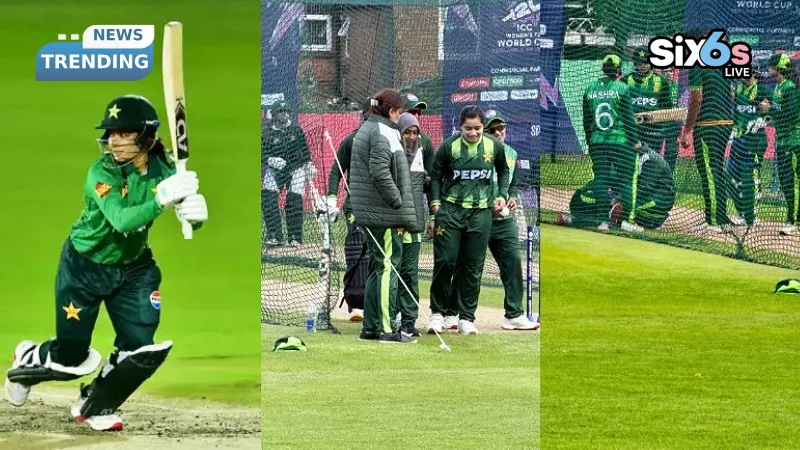
Pakistan captain Fatima Sana took a blow to her right shin during a Birmingham net session on Saturday, one day before Pakistan’s ICC Women’s T20 World Cup 2026 opener against India at Edgbaston. She was immediately escorted off the practice ground by support staff. The incident has exposed a structural weakness in Pakistan’s bowling plan that goes beyond one player’s shin.
What Happened at Pakistan’s Net Session
On Saturday afternoon at Edgbaston, Fatima Sana was struck on her right shin while bowling in the nets. The blow came from a low, flat back-foot drive off the bat of opener Ayesha Zafar, which cannoned into Sana’s front leg as she followed through. She was taken off the practice ground immediately by support staff, less than 24 hours before the biggest fixture of the group stage. The PCB issued no immediate statement, and the absence of any communication from official channels allowed speculation to run unchecked through the afternoon. Sana is not just Pakistan’s captain: she is the spearhead of their new-ball attack, tasked with extracting early swing and seam movement against India’s dangerous top order.
Fatima Sana Injury Pakistan Women’s T20 World Cup 2026 India
At Pakistan’s pre-match press conference, Sana offered a more measured account than the initial reports suggested. She explained the blow came off Ayesha Zafar’s bat and struck her on the knee rather than purely the shin, adding she believed the injury was good now and that she was hopeful of being fit for the India game. The PCB has not issued any separate medical bulletin, scan result, or formal fitness clearance through official channels.
The only public confirmation of her status remains Sana’s own verbal assurance, with no independent statement from team physios or the board confirming she trained fully after the blow. That silence leaves the door open to late changes on match morning, including the possibility of Sana playing in a restricted bowling capacity even if passed fit to bat.
Her Powerplay Role Is Irreplaceable Against Mandhana
Sana’s value to Pakistan is specifically about what she offers with the new ball. She is one of the very few genuine seam-bowling options in this squad capable of bowling with control and carry in the first six overs on an English surface, conditions that reward seam and bounce far more than spin. Smriti Mandhana is precisely the kind of batter who punishes hesitation with the new ball: an opener who thrives on width and pace through the powerplay, with the footwork to drive through extra cover from the first over.
Shafali Verma adds a second threat at the top, capable of clearing the boundary from ball one with minimal regard for the match situation. If Pakistan walks out with Sana’s overs restricted, their powerplay attack loses its primary swing-and-seam option against a top order built to exploit exactly that gap.
What PCB’s Silence Tells Us
Pakistan’s other seam options are limited. Diana Baig, recalled ahead of this World Cup, is the most obvious alternative new-ball option, but reports note she has looked rusty since returning to the side. Beyond Baig, Pakistan’s attack relies heavily on spin: Sadia Iqbal, Nashra Sandhu, and leg-spinner Tuba Hassan form the core, with Sadia Iqbal most likely to lead the attack if Sana is curtailed. That points to an uncomfortable scenario: Pakistan may be forced to open with a spinner against India’s left-hand-heavy top order, a tactical gamble that goes against the conventional logic of using the new ball’s lateral movement against fresh batters.
Teams fully confident in a player’s fitness typically have physios or management issue a quick clarifying statement, particularly ahead of a fixture as scrutinised as an India-Pakistan World Cup opener. The fact that PCB has not done so suggests the final call on Sana’s workload may come right up to the toss. The Fatima Sana injury, Pakistan Women’s T20 World Cup 2026 India situation may yet resolve cleanly, but until it does, Pakistan’s powerplay plan at Edgbaston remains a genuine unknown.