
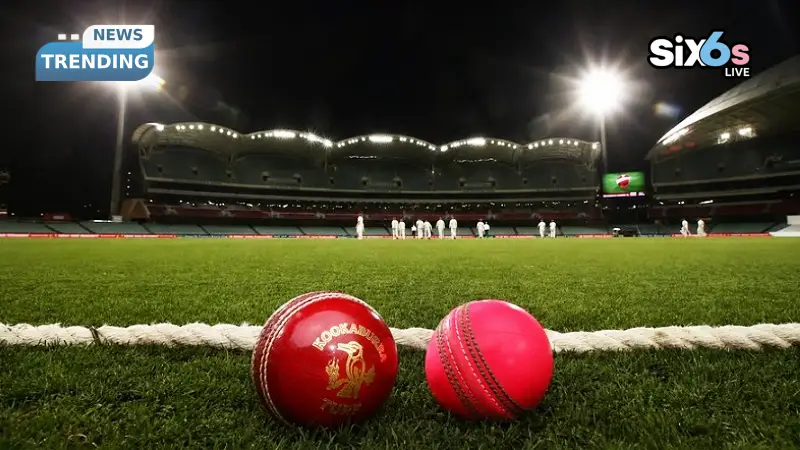
The ICC’s May 30 Board meeting in Ahmedabad carries an item that sounds administrative and isn’t. Allowing teams to switch from a red ball to a pink ball mid-Test when weather forces play under lights is the kind of procedural change that becomes structural fast. The BCCI hasn’t hosted a pink-ball Test since March 2022. Their stated position hasn’t shifted. And without BCCI alignment, no ICC playing conditions change achieves real traction regardless of what the Board formally approves.
What the Proposal Actually Changes
The ICC Cricket Committee, chaired by Sourav Ganguly, aired the proposal at a virtual Chief Executives Committee meeting on May 22. The specific mechanism: a red-to-pink switch during a conventional daytime Test when weather interruptions force play to continue under lights, activated only if both teams agree before the series begins. If the Board approves it in Ahmedabad on May 30, the playing condition takes effect from October 1, 2026.
The consent requirement is already a significant dilution. A team philosophically opposed to the pink ball can simply withhold consent series by series without formally opposing the rule. That structural escape route matters when the BCCI is involved.
The same agenda covers head coaches being allowed onto the field during ODI drinks breaks, a reduction of the T20I innings break from 20 minutes to 15, Hawk-Eye access for on-field umpires to identify illegal bowling actions, and a possible WTC expansion from 9 to 12 teams.
ICC Pink Ball Test Cricket Proposal 2026, Boards and Their Positions
| Board | Pink Ball Tests Hosted | Last Pink Ball Test | Stated Stance |
| Australia | 13 | Dec 2025 vs England (Brisbane) | Pro hosts regularly, treats it as a priority |
| England | 2 | Aug 2022 vs South Africa | Cautiously supportive; ball quality concerns raised |
| India (BCCI) | 3 | March 2022 vs Sri Lanka | Opposed matches end too quickly |
| New Zealand | 1 | March 2018 vs England | Open to more |
| South Africa | 1 | Dec 2017 vs Zimbabwe | Not stated publicly |
| Pakistan | 0 home (2 in UAE) | Oct 2021 (away) | No official home policy |
| West Indies | 1 | Jun 2018 vs Sri Lanka | Not stated; record 1W/4L |
India’s Reluctance Has a Paper Trail
Ganguly’s arrival as BCCI president in 2019 produced India’s only moment of genuine pink-ball enthusiasm. He organised the inaugural day-night Test against Bangladesh at Eden Gardens, which drew 43 million viewers and clocked 2 billion viewing minutes, the highest Day 1 viewership for any Test in 2018-19 per BARC India data from March 2020.
That momentum didn’t hold. India’s subsequent pink-ball Tests at home, against England in 2021 (won by 10 wickets in two days) and Sri Lanka in Bengaluru in March 2022 (three days), both ended before the fourth day. The short matches hardened official BCCI thinking. In 2024, Jay Shah set out their position:
“We will have to increase the amount of interest in the public for the pink-ball Test. If you recall, the Tests ended in two to three days. Everyone wants to watch a Test match lasting four to five days. Once they get more used to it, we will do more pink-ball Tests.” — Jay Shah, BCCI Secretary, 2024
India has played no pink-ball Tests at home since, and none are scheduled.
Australia Pushes, BCCI Pulls
Australia has hosted 13 of 24 global pink-ball Tests and won 12 of them. Their entire home summer structure is built around day-night Tests at Adelaide, and the 150th Anniversary Ashes Test at the MCG in 2027 will be played under lights. Their support for any ICC expansion of the format is near-certain. England has hosted twice and backed the concept with reservations; both Alastair Cook and Ben Stokes raised concerns about the consistency of the pink Dukes ball compared to the red.
ICC pink ball Test cricket proposal 2026 structural problem is revenue. India accounts for an estimated 80-90% of global cricket broadcast revenue. The ICC Board meeting is being held in Ahmedabad alongside the IPL 2026 Final at the Narendra Modi Stadium, a location that is itself a statement about where power sits. PCB Chairman Mohsin Naqvi will attend virtually.
The outcome on May 31 will reveal less about the pink ball than about how much the ICC is willing to push a format India hasn’t embraced in four years.
Cricket never stops, and neither do we. Follow Six6slive for the latest news, in-depth features, and exciting updates from the world of cricket. Dive into the action now!