
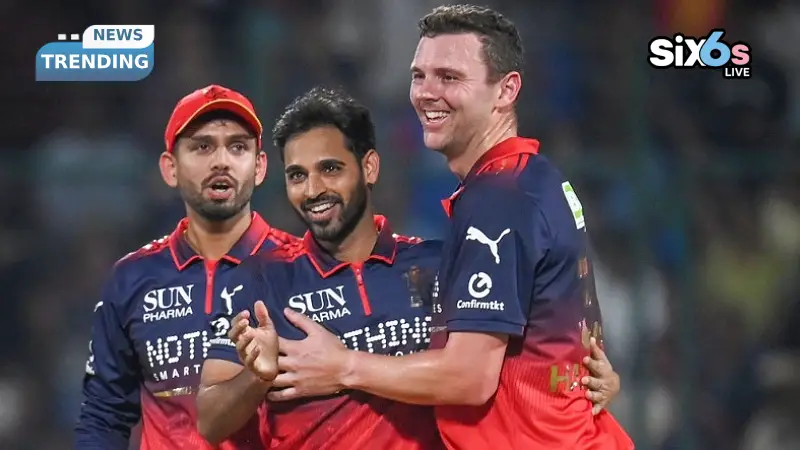
Bhuvneshwar Kumar is 36, hasn’t played for India since November 2022, and carries no headline price tag. He’s also the leading wicket-taker with 21 scalps, the most economical powerplay bowler in the competition, and the man his own partner just compared to Pat Cummins and Mitchell Starc. When a bowler of Hazlewood’s calibre defers openly to his new-ball partner, the numbers behind that deference are worth understanding.
What Hazlewood Said and Why It Matters
In an ESPN interview published May 17, 2026, Hazlewood made a direct comparison: “It’s a little bit like bowling with Patty [Pat Cummins] and Starcy [Mitchell Starc] for Australia. Bhuvi probably pitches it up a little more and swings the ball. I can hit the seam and get a bit of bounce. It’s nice to have balance in your attack.”
After RCB dismantled Delhi Capitals, DC reduced to a record IPL low of 13/6 in six overs, Hazlewood taking 4/12 and Bhuvi 3/5 in the powerplay, Hazlewood wasn’t claiming equal credit. He said plainly, “I just followed Bhuvi. There was a little bit of swing in the first six overs.” A world-class bowler identifying a tactical anchor doesn’t do that unless it’s true.
Bhuvneshwar Kumar Powerplay Partnership: What the Numbers Say
| Bowler | PP Wickets (2026) | PP Economy (2026) | Career IPL Economy | Season Wickets |
| Bhuvneshwar Kumar | 12 | 7.00 | 6.53* | 21 |
| Josh Hazlewood | , | 5.8 (Wins Only) | 8.28 | 9 |
Bhuvi’s 12 powerplay wickets lead every pacer in the tournament. His economy of 7.00 in that phase is joint-best alongside Mohsin Khan of LSG among all bowlers with 50-plus powerplay balls delivered this season. His career powerplay economy of 6.53 ranks among the three best ever recorded in IPL powerplay history. Every comparable fast bowler, Cummins, Starc, and Bumrah, posts a higher economy across that phase.
Why the Cummins-Starc Comparison Holds Up
Hazlewood’s analogy isn’t just atmospheric, it’s structurally accurate. Starc’s career IPL economy is 8.65 across 55 matches. Cummins sits at approximately 8.50. Neither has produced a single IPL season combining Bhuvi’s current economy rate and powerplay wicket volume simultaneously.
The stylistic contrast Hazlewood describes also mirrors the Australian dynamic precisely. Bhuvi bowls full, swings the ball late, and pins batters to the crease. Hazlewood seams and bounces from the other end. One creates the doubt, the other creates the pressure. It’s the same division of labour Cummins and Starc have used in Test cricket for years, applied to T20’s most Test-like phase.
Test-Match Craft Winning T20’s Most Dangerous Phase
The powerplay is T20 cricket’s closest equivalent to a Test opening spell. The new ball moves. Fielding restrictions allow an attacking cordon. Batters face genuine uncertainty they don’t encounter in the middle overs. Against DC, ESPNcricinfo noted Bhuvi “hammered away on a Test-match length while generating late swing in both directions into the fifth over.“ Hazlewood did the same from his end.
Neither bowler has reinvented himself for T20. Both are classical fast-bowling technicians exploiting the one phase of the format where classical fast bowling wins consistently. RCB’s results confirm it: the DC powerplay (13/6), MI (28/3 in three overs), and KKR (Finn Allen removed early, restricted to 56/2) all followed the same pattern. Bhuvi strikes, RCB take control, and the opposition never fully recovers.
Is Bhuvneshwar Kumar’s IPL 2026 powerplay campaign the greatest single-season new-ball performance in the tournament’s history? Drop your argument in the comments.
FAQs
What did Hazlewood say about bowling with Bhuvneshwar Kumar?
Hazlewood compared the partnership to bowling alongside Pat Cummins and Mitchell Starc for Australia, citing Bhuvi’s full length and swing against his own seam-and-bounce approach as the source of RCB’s new-ball balance in the powerplay.
How many wickets has Bhuvneshwar Kumar taken in IPL 2026?
Bhuvi leads IPL 2026 with 21 total wickets, including 12 in the powerplay, the most by any pacer in the tournament this season. His powerplay economy of 7.00 is joint-best among all bowlers with 50-plus powerplay balls delivered.
Who benefits most from the Bhuvneshwar Kumar powerplay partnership?
The Bhuvneshwar Kumar powerplay partnership makes Hazlewood significantly more dangerous by giving him a contrasting swing option from the other end, with RCB reducing opponents to 13/6, 28/3, and early wicket situations in three separate powerplay contests this season.
Why is Bhuvneshwar so effective in T20 powerplays?
Bhuvi combines late swing, precise seam presentation, and Test-match lengths during the one phase of T20 cricket where new-ball movement gives pace bowlers a genuine advantage over batters. His career powerplay economy of 6.53 ranks among the three best ever recorded in IPL powerplay history.
How does Bhuvneshwar Kumar compare to Pat Cummins in IPL?
Bhuvi’s career powerplay economy of 6.53 significantly undercuts Cummins’ career IPL economy of approximately 8.50, making him the more economical new-ball operator across that phase by a wide margin. No comparable fast bowler, Cummins, Starc, or Bumrah, has matched his economy rate over 100-plus powerplay overs in IPL history.