
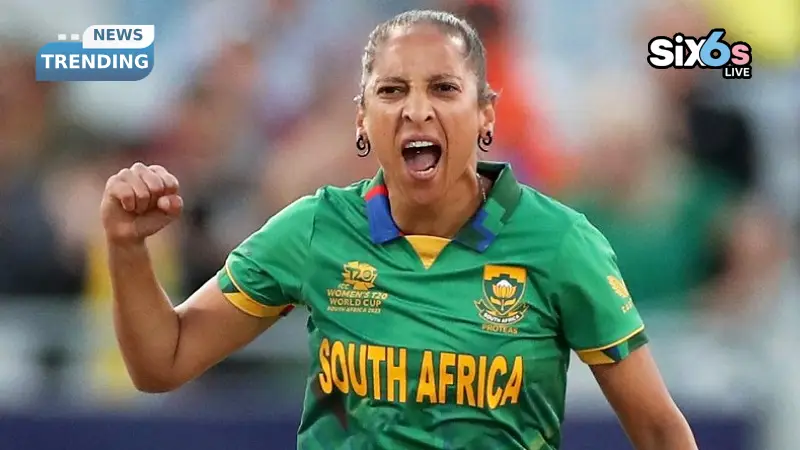
Shabnim Ismail reversed her retirement and immediately changed the conversation around South Africa’s title chances in England. Marizanne Kapp returns from injury to restore all-round balance. Laura Wolvaardt leads the side for a second consecutive global tournament with one of the most complete bowling attacks the Proteas have ever assembled for an ICC event. Two runner-up finishes created the question. This squad looks structurally built to finally answer it.
Ismail’s Comeback Changes Everything
Ismail’s 123 Women’s T20 International wickets make her one of the most accomplished bowlers entering this tournament. That number doesn’t fully explain why her recall matters as much as it does.
South Africa’s pace attack, without her carried experience, lacked a genuine powerplay enforcer capable of generating swing and pace against settled top-order batters. Ismail provides exactly that. England’s venues in Manchester and Birmingham historically reward seamers who attack early, and her ability to swing the ball at high pace gives the Proteas a tactical weapon that directly suits host conditions.
Her return also signals something beyond selection. A player who reversed retirement specifically for this tournament carries motivation that statistics can’t measure. South Africa’s bowling unit gains both her wickets and the momentum her presence creates within the squad environment before a ball is bowled.
Wolvaardt Leads a Stable Core
Leadership continuity matters as much as Wolvaardt’s batting at tournaments where ICC knockout pressure regularly exposes sides rebuilding around new captains. South Africa enters England without that problem.
Her partnership with Tazmin Brits shapes the batting approach from the first over. Both provide powerplay composure that allows Chloe Tryon and Dane van Niekerk to attack in the middle and death overs with clearly defined roles settled before the toss. That structure prevents mid-innings confusion on unfamiliar surfaces, where batting lineups collapse not through poor technique but through role uncertainty.
Wolvaardt’s current ICC rankings position confirms she arrives at peak confidence rather than rebuilding form. South Africa’s batting foundation doesn’t need to find itself during the group stage.
Women’s T20 World Cup Bowling Depth
Women’s T20 World Cup pace attacks are usually built around one or two strike bowlers supported by economy options. South Africa now carries genuine depth across multiple simultaneous threats.
Ayabonga Khaka partners Ismail with the new ball, giving the Proteas two experienced seamers capable of creating early damage on surfaces that reward movement. Nonkululeko Mlaba’s left-arm spin adds variation through the middle overs. Tumi Sekhukhune and Nadine de Klerk extend support options as conditions shift across venues during the group stage.
Two consecutive runner-up finishes suggest previous bowling attacks were strong enough to reach finals but not consistently dominant enough to win them. This squad’s bowling depth surpasses both editions, which is the clearest structural argument for a different result this time.
Kapp’s Return Completes the Balance
Kapp’s value isn’t captured by any single statistic. Her importance lies in what she enables for every other player in the XI.
When she bowls, South Africa can deploy Ismail and Khaka across different phases knowing the medium-pace support at the other end won’t leak freely. When she bats, the recognised batters above her can take the risks their roles demand without protecting a fragile tail.
Her injury absence created a structural gap that Annerie Dercksen and Kayla Reyneke partially filled. Kapp’s return doesn’t diminish their contributions. It shifts them into supporting roles they’re naturally better suited for, which makes the squad’s overall balance considerably more reliable heading into the knockout rounds.
Cricket never stops, and neither do we. Follow Six6slive for the latest news, in-depth features, and exciting updates from the world of cricket. Dive into the action now!