
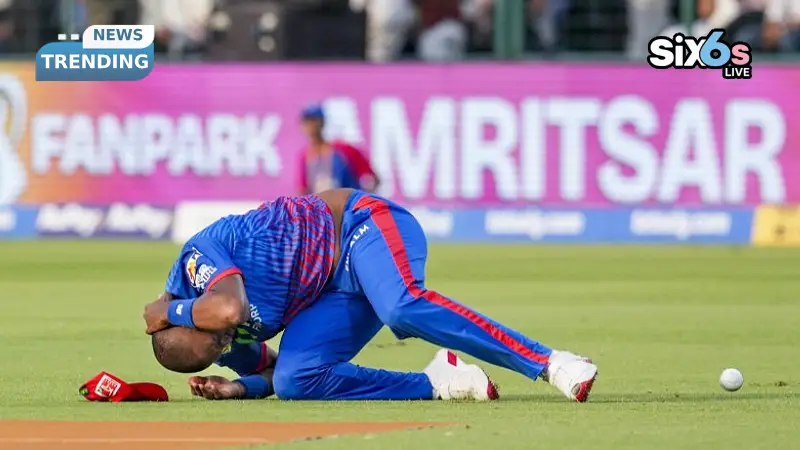
Lungi Ngidi is stable after being taken to the hospital following a head injury during the Delhi Capitals’ match against the Punjab Kings, but the disruption to DC’s bowling structure was visible before the replacement had bowled a single ball. The concussion substitute rule was activated, a fresh bowler entered the attack, and the match moved forward. Delhi’s original bowling plan didn’t. On a ground where pace control and death over variation decide results, losing their most reliable fast bowler before he had delivered a single delivery reshaped every phase that followed.
One Fall Disrupts the Whole Attack
Ngidi ran back for a boundary catch at the Arun Jaitley Stadium, misread the flight, and landed hard on the back of his head. Medical staff arrived within seconds. Play stopped, the stretcher came out, and he was helped off. From a welfare standpoint, his stable condition is the best possible outcome. Tactically, Delhi had lost their first-choice pace bowler before the bowling innings had even started.
His value in DC’s attack doesn’t appear in any single spell. It builds across the innings through hard lengths that restrict right-handers for room, carry, and seam movement that Delhi’s surface rewards, and the kind of pressure that creates wicket opportunities rather than simply conceding dots. Removing him before he bowls reshapes the entire rotation. The overs he would have covered went to bowlers who weren’t designed to fill that role, and the gap showed across every adjustment that followed.
IPL 2026 Concussion Sub Reshapes Everything
The concussion substitute protocol kept the match moving legally. In practice, concussion swaps rarely function as cleanly as the rule implies. The replacement entered without match rhythm, without the warmup Ngidi had completed during the fielding innings, and had to absorb the tactical demands of a high-pressure chase defence immediately on arrival.
Punjab Kings were chasing a target that KL Rahul had made close to unreachable. The replacement bowler had to manage an aggressive batting lineup without Ngidi’s specific pace profile as a fallback. Any bowling plan built around one bowler’s particular skill set loses its shape the moment that bowler is replaced by someone working from a different arsenal entirely. DC’s management adjusted as well as the situation allowed, but improvised bowling plans in the final four overs of a T20 rarely match the precision of a prepared one. There is no clean equivalent for a bowler of Ngidi’s calibre, and Delhi felt that absence precisely when they could least afford it.
Rahul’s 152 Raises the Defending Stakes
KL Rahul’s unbeaten 152 had already set an enormous context before Ngidi’s injury became the central story. Delhi had posted a total that most bowling attacks at this venue would back themselves to defend. What changed was the combination available to protect it.
Without Ngidi, DC’s remaining pace bowlers extended their spells into phases where their effectiveness normally drops. Spinners absorbed overs the plan had allocated to pace. Against Punjab Kings’ lower order, built for acceleration through the final overs, each rotational adjustment produced a slightly worse outcome than DC’s original structure would have allowed. The total Rahul had built felt smaller in defensive terms as the bowling unit worked through improvised rotations without its central piece. Delhi’s scoreboard margin and their execution margin didn’t match, and that gap widened as the chase developed.
DC’s Campaign Faces Its Biggest Test
Head injuries require medical clearance that can’t be shortened, and DC can’t plan around Ngidi for their next fixture. Depending on the assessment timeline, the absence may extend across multiple matches at a point where every result directly shapes playoff positioning.
Ngidi fills a role in Delhi’s attack that their alternatives don’t replicate cleanly. He controls specific phases, applies pressure in the overs between the spin attack and the death, and takes wickets when the margin for error is at its smallest. The DC squad has bowling options, but none who combine his pace, control, and tactical awareness across a full match. How the team configures their attack in the coming weeks of IPL 2026, which combinations they trust under pressure, and whether the remaining bowlers absorb the extra load will determine whether this incident marks a turning point in their season or a setback they recover from quickly.
Cricket never stops, and neither do we. Follow Six6slive for the latest news, in-depth features, and exciting updates from the world of cricket. Dive into the action now!