
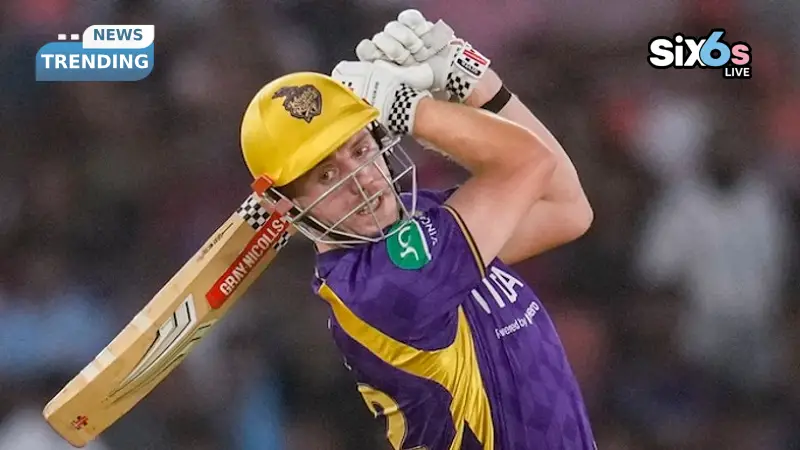
Cameron Green played one of the better individual innings KKR have seen this season. Seventy-nine off 55 balls, built carefully after a top order collapse, with partnerships constructed on composure rather than panic. It should have been the foundation of a competitive total. Instead, it became the centrepiece of a match KKR found a way to lose anyway through death over chaos that undid everything Green had built and handed Gujarat Titans a chase so comfortable that Shubman Gill barely broke a sweat. That’s the KKR pattern in full. One player holds the innings together. Everyone else makes his effort irrelevant.
Another Top Order Disaster
KKR’s plan walking into this match was aggressive intent from the first over. By the time the power play ended, they were 32 for 3, with Ajinkya Rahane dismissed on the very first ball. The intent was there. The execution wasn’t even close.
Gujarat’s bowlers didn’t produce anything extraordinary to cause that collapse. They bowled tight lines, held their lengths, and waited for KKR’s batters to make decisions that handed wickets over. KKR obliged repeatedly. The pattern of aggressive shot selection against disciplined bowling producing cheap dismissals has appeared in enough matches this season that it can no longer be dismissed as bad luck. It’s a structural problem in how this team approaches the power play, and the captaincy hasn’t found a way to correct it mid-innings when the first wicket falls early and signals that the aggressive plan isn’t working.
IPL 2026 and Green’s Lone Fight
What Green did in the middle of this innings was the most disciplined batting KKR produced across IPL 2026 in this match. He didn’t panic when the top order fell around him. He took time to assess the surface, identified which bowlers were offering scoring opportunities, and constructed partnerships, 55 with Rovman Powell being the most significant, that rebuilt the innings from a position that could easily have become a rout.
His acceleration once settled was measured rather than reckless, and he converted starts into genuine impact rather than getting out in the thirties the way KKR’s middle order batters have done repeatedly this season. The problem wasn’t Green. It was the absence of anyone around him willing or able to contribute with similar clarity. When one batter is doing everything and the rest of the lineup is finding ways to get out, the total reflects the collective rather than the individual. Green’s 79 deserved a score above 190. It got 180, and that gap tells the real story.
Five Wickets, Twenty-Six Runs, Gone
KKR were positioned to cross 200 as they entered the final four overs. What followed was one of the most damaging collapses of their season. Five wickets for 26 runs in the death overs didn’t just cost them runs; it cost them the psychological foundation of a score that requires a response.
The collapse came from the same source it always does. No clear finisher. No defined role for who bats at what moment. Batters are trying to hit boundaries in situations where rotating strike and finding twos would have been more effective. When pressure concentrates in the final overs, and no one in the lineup has a clear mandate for how to handle it, the result is the kind of frantic batting that produces wickets instead of boundaries. KKR’s death over problem is no longer a tactical concern that needs monitoring. It’s a recurring event that needs structural fixing before the next match, not before the next tournament.
Gill Makes the Chase Look Easy
Gujarat’s response was almost insulting in how uncomplicated it was. Gill and Sai Sudharsan put on 57 in the first five overs, removing any pressure the total might have created before it had time to settle on the chasing side. From that point, the match was never really in doubt.
Gill’s 86 off 50 balls combined timing, placement, and intelligent accumulation in a way that KKR’s batting never managed in the first innings. He rotated strike when rotation was required, attacked when the field offered a gap, and never once played the kind of reckless shot that derailed KKR’s innings repeatedly. With 23 needed from 3 overs, the result was academic. The contrast between Gill’s innings and KKR’s collective effort wasn’t just about quality. It was about knowing your role and executing it without confusion. KKR has batters capable of that clarity. They just haven’t found a way to produce it all at the same time yet.
Cricket never stops, and neither do we. Follow Six6slive for the latest news, in-depth features, and exciting updates from the world of cricket. Dive into the action now!