
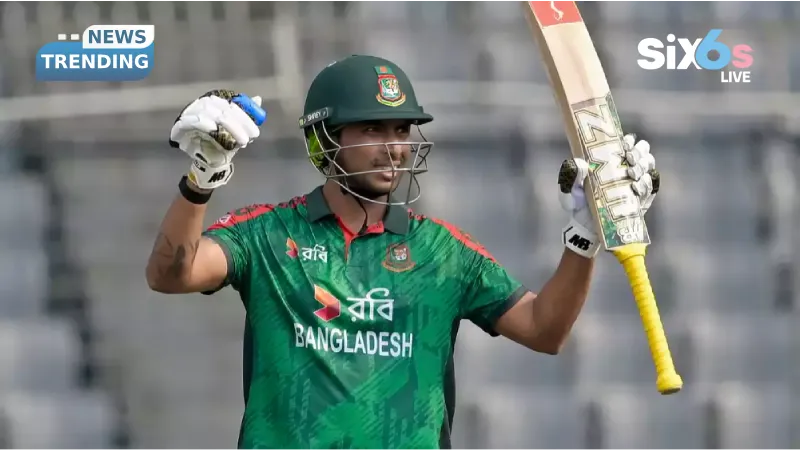
Bangladesh’s opening setup for the New Zealand ODI series is close to picking itself. Tanzid Hasan has made a strong case for his spot, Saif Hasan has the full backing of team management, and the combination has delivered the kind of consistency selectors are reluctant to break. For a player who has been around international cricket for years, that kind of settled hierarchy is the hardest thing to crack. Experience alone won’t open the door. Something else has to shift first.
Tanzid Has Made the Spot His
Tanzid Hasan’s case for the opening position isn’t built on potential anymore. It’s built on delivery. A powerplay century that helped Bangladesh seal a series win isn’t a number you overlook when picking the next XI. It’s a performance that resets what selectors expect from that position going forward.
Beyond the big scores, it’s his approach that suits the modern ODI template. Tanzid attacks from the first over, takes on pace bowling early, and gives the middle order the freedom to play naturally rather than spend the first ten overs recovering from a slow start. That combination of aggression and output makes him very difficult to drop. Selectors don’t move against that kind of form without a compelling reason, and right now, no compelling reason exists.
Soumya Sarkar and the Role Problem
The issue here isn’t form in isolation. It’s a role fit. In the current Bangladesh setup, both opening slots carry a defined function. One opener needs to provide early acceleration. The other needs to hold shape while partnerships develop around them. He doesn’t clearly occupy either end of that spectrum based on recent output.
His recent innings show he’s in reasonable touch. But reasonable touch doesn’t earn a place when the competition is performing well above that level. Against New Zealand’s disciplined seam attack, Bangladesh want openers who know exactly what their job is from ball one. Right now, the question of what role Soumya fills in this XI doesn’t have a clean answer, and that uncertainty is costing him.
The Saif Hasan Complication
The second challenge facing Soumya Sarkar is that he isn’t just competing against a player in form. He’s competing against a project.
Saif Hasan’s international returns haven’t been consistent, but a century in an intra-squad fixture has kept him firmly in the team’s thinking. When management sees a player performing well in practice environments, they back it with patience. Bangladesh has made clear they’re willing to invest time in Saif’s development rather than rotate based on reputation alone. That means Soumya is up against an opponent who carries both the selectors’ belief and a runway to grow into the position, not just current numbers to beat.
What Changes His Chances?
Selection in cricket is rarely permanent in either direction. Soumya stays involved in the squad environment, which keeps him ready when a window opens. The real question is what needs to happen for that window to appear.
The most straightforward route is a dip in form from those ahead of him. If Tanzid has a rough run or Saif continues to find international bowling a step beyond what he’s handled in practice, the conversation around the opening spots shifts quickly. New Zealand’s conditions could also play a role. If the surfaces demand a specific type of player or a more measured approach at the top, team management may look differently at what the position requires.
Soumya has enough experience to know squads shift without warning. Staying sharp while others hold the position is, for now, his only realistic play. Whether Bangladesh needs him before this series ends depends almost entirely on factors outside his control.
Cricket never stops, and neither do we. Follow Six6slive for the latest news, in-depth features, and exciting updates from the world of cricket. Dive into the action now!