
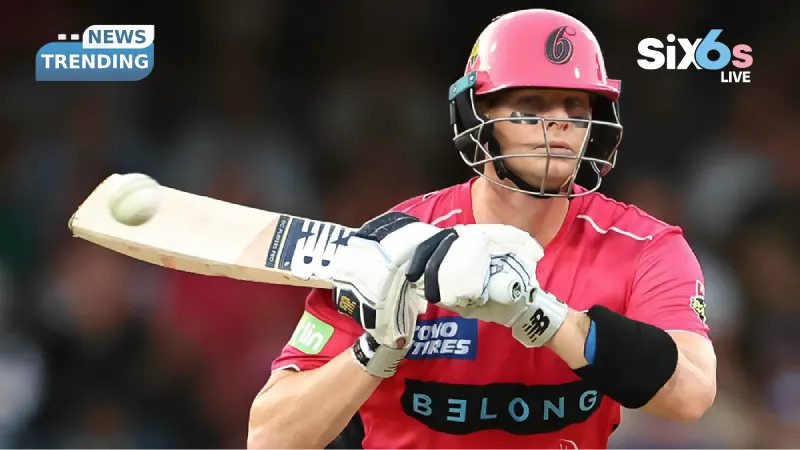
Smith’s signing with Sialkot Stallionz is a calculated move to revive his short-format career and strengthen his push for Australia’s T20 plans ahead of the 2026 cycle and the 2028 Olympics. By joining a new Pakistan Super League team, he gains high-intensity franchise exposure at a time when questions remain about why he was not selected for the T20 World Cup squad. Simply put, Smith is using PSL cricket as a competitive pathway to prove he still belongs in Australia’s evolving T20 setup.
Direct Route Back to Relevance
Smith’s exclusion from the Australian T20 team is clearly not about his past performance – it is about how he fits into the current group of players. The current opening line-up of Mitch Marsh and Travis Head has demonstrated the ability to aggressively score during the powerplays, which is a key area that the selection panel wants to see. His PSL signing puts him in a competition where speed, flexibility, and high strike rates are continually tested.
Domestic franchise cricket provides several things that bilateral international series do not: a variety of bowlers, varying pitches, and match-winning situations. For a player looking to change their public perception, this type of competitive environment will be more important than their domestic run-scoring statistics.
Why Steve Smith’s PSL Signing Fits His Skillset
The Pakistan Super League team selection process is deliberate and thoughtful, and not simply a matter of chance. Historically, PSL surfaces have rewarded batsmen who are able to manipulate gaps with their bat rather than simply being big hitters. On slower surfaces with some two-paced wickets in the series, teams will need to rotate the strike effectively and be aware of the game situation.
PSL games are often played out in a way where the outcome of the contest is determined by how well the middle order can contain the opposition’s scoring during the middle overs. Smith’s ability to rebuild and then accelerate late in the innings could be very useful for Australia if he were to be selected as a number three or an opening batsman in Australia’s limited-overs squads.
Recent T20 Form Shows Growth
Smith’s recent performance domestically suggests that the scope of where he plays is wider. During his last stint with the Big Bash League, he made 299 runs from six innings while striking at a 167.97 clip, which is significantly higher than his career strike rate of 125.45 as an International player. He also made a 41 ball Century in the process, showing intent, not just accumulation.
In addition, the statistics refute any criticism of Smith’s slow scoring pace in the past. Should Smith maintain a similar speed of play during his Smith PSL 2026 participation, it would provide selectors with solid evidence to support their belief that his style of play has evolved to reflect what is now contemporary. It is just what the T20 comeback story relies upon: proof, not reputation.
Competition With Australia’s Core
The greatest barrier to this is still opportunity. Marsh, Head, Maxwell, and David will be taking the three aggressive spots preferred by Australian selectors. Smith will have to provide either a higher level of batting consistency than his competitors or greater tactical flexibility.
The key here is with Steve Smith’s Sialkot Stallionz contract. He has demonstrated the ability to bat in various locations on the field and handle multiple forms of bowling. In addition to batting under pressure at night or on slow tracks to help win games for his team, he has also demonstrated that he can be flexible. The selection committee views flexibility as an asset to compete in international competitions such as the Olympics, which are now becoming visible.
Stay updated on the latest cricket news and exciting updates at Six6slive. Dive into our in-depth articles and analyses to connect with the action today!