
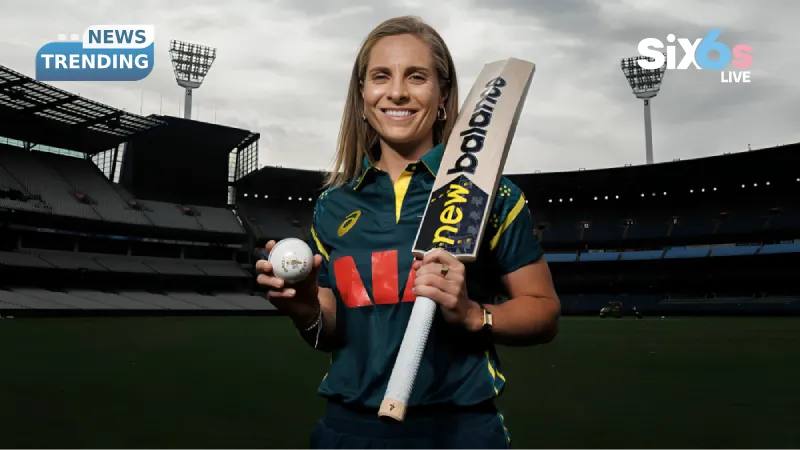
Australia doesn’t typically blink first. They plan. They dominate. They make their transitions with the cool, calculated efficiency of a team that has been on top for nearly two decades. Therefore, when it was announced that Australian captain Alyssa Healy will be replaced by Sophie Molineux as captain across all formats, it felt quietly radical, not crazy, but revealing.
On paper, this is a little surprising. The last time Sophie Molineux participated in either a T20I or Test match was in 2024 due to injuries to her knees. She was managed by Cricket Australia’s workloads throughout the previous ODI World Cup, and she did not complete an entire WBBL season. Yet here she is replacing a woman who has been Australia’s captain during multiple world championships and has dramatically changed how women play aggressively in women’s cricket.
Leadership Chosen Over Match Fitness
The team rarely selects a new captain when there will be significant challenges with that player’s health and ability to play. However, Australia has selected captains in the past when the focus was on developing the best way to manage an opposition side rather than ensuring continuity through the season (e.g., when Meg Lanning returned as captain after her injury, she led by example using tactics over long-term selection).
The selectors believe Molineux can lead through her brain (cognitive) rather than through consistent physical presence (she is a left-arm spinner who is aware of the importance of timing, which bowlers she should bowl against, and how to handle pressure throughout matches). When asked about her potential lack of availability for games, national selector Shawn Flegler said that he knows she will not play in all games. This is not a weakness; it is a strategic decision.
The Renegades Blueprint
This appointment does not simply materialize out of thin air. Molineux led the Melbourne Renegades to a drought-ending WBBL championship in the 2024-25 season and transformed a historically underachieving team into an overall cohesive, adaptable unit.
It’s clear that what has been most evident is not the style of the players’ roles, but rather how clearly each player knew their respective role on the field. In addition, with the increased boldness in the rotation of bowlers, the young players have thrived in the low-noise, “leadership” environment created by the team leaders. This is the exact type of skill set Australia will need once Healy, Schutt, and other older players are no longer able to play at the top level and begin to transition towards retirement.
Why McGrath Wasn’t the Obvious Answer
Tahlia McGrath is the correct vice captain of the Australian women’s cricket team. McGrath has captained Australia on sixteen occasions across all formats, providing stability when Alyssa Healy is absent. McGrath will provide an element of execution and balance to the team, but not structural change.
Australia did not just want continuity; it wanted to evolve without being chaotic. By keeping McGrath as vice-captain, Australia gets tactical consistency, and by allowing Molineux to set a long-term direction, it gives them the potential for a smooth ride. McGrath and Molineux are two engines, one sets the course, the other provides a smooth journey.
Gardner’s Promotion Reveals the Future
Ashleigh Gardner was named as joint vice captain, with many seeing this as the strongest evidence of a changing team culture for the Australian team. She also represents Australia’s potential future powerhouse with her ability to be multi-skilled, fearless, and format-adaptible.
She adds depth to the leadership group and will have the added benefit of being able to fill in if needed. Most importantly, she shows that Cricket Australia has an abundance of faith in multi-disciplined players – a requirement in today’s women’s game in which specialising is rapidly becoming a luxury.
Stay updated on the latest cricket news and exciting updates at Six6slive. Dive into our in-depth articles and analyses to connect with the action today!