
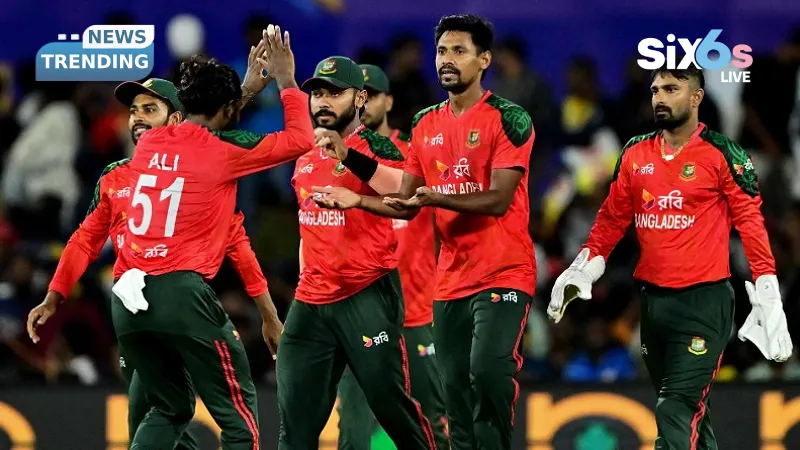
Three weeks before the 2026 T20 World Cup, Cricket is in a fight for sovereignty and not over swing or spin. The refusal by Bangladesh to play their scheduled games in India has turned the logistical side of the game into a public and highly visible political chessboard.
The current setup puts Bangladesh into a group with England, West Indies, Nepal, and Italy (with 3 matches being played in Kolkata and 1 in Mumbai), but the BCB has asked for their location to be changed to Sri Lanka due to “government-level” security concerns about the safety of players, fans, and media.
When Security Anxiety Meets Tournament Reality
The standoff reveals much more than a preference for venue; it shows how modern governing bodies of cricket (in this case, the International Cricket Council) weigh international schedules in relation to the feelings of their national stakeholders. The Board’s demand for relocation is a matter of procedure, not simply an emotional appeal – it is based upon a directive from the Government of Bangladesh and a concern by other stakeholders.
Shifting venues so close to the start date is operationally a challenge to the ICC – broadcasting schedules, ticket sales, and group logistics all operate on fixed timetables. And if the ICC refuses the BCB’s request, they risk showing indifference to player/spectator safety, which would be a classic dilemma for the ICC: remaining neutral or being flexible.
Diplomacy Triggered by One Squad Decision
The reason for this increase is due to the fact that Bangladesh removed Mustafizur Rahman from its Kolkata Knight Riders (KKR) IPL squad. There was no explanation as to why the team removed him; his removal occurred at the same time that the two countries were experiencing declining diplomatic relations.
Bangladesh responded immediately to this removal, first by banning all of IPL’s broadcasts nationally and then by refusing to have their World Cup matches played in India. While player removals occur each season, in the larger context of the situation, this removal became an accelerator of the deteriorating relations between the two nations. History has also shown us examples of similar sparks to create controversies in cricket, including the various Pakistan-India match cancellations and the isolation years of South African sports that used sports as a means to be involved in international conflict.
Negotiation Room Dynamics Behind Closed Doors
Saturday’s meeting exposed diplomatic caution rather than conflict. The ICC delegation, which included Gaurav Saxena and Andrew Ephgrave, met with the BCB leadership, led by Aminul Islam, as well as senior BCB executives. Ironically, even the logistical arrangements of attendance reflected this: Saxena attended virtually due to delays in obtaining a visa.
A proposed plan for discussion at the meeting is to place Bangladesh in a different group so that there would be minimal disruption to the schedule, a compromise that preserves the overall structure of the tournament but acknowledges the concerns raised. This is an example of bureaucratic creativity that cricket administrators often turn to when the politics of a situation outpace its planning.
Risk Assessments Versus Perception Economics
The report stated that there was “no” direct threat to teams, but described the overall environment as “moderate to high risk.” It is a subtle distinction. Stakeholders’ belief in the safety of their investments at large-scale international events is driven by perceptions, not probabilities.
Perception has supplanted objective data for Bangladesh, and perception of fair play and inclusion has equal importance to the International Cricket Council (ICC). In today’s world of cricket economics, credibility will be just as important as television broadcasting rights. If teams perceive that their safety assurances can be negotiated, then precedent will become policy.
The fight for which venue this series should take place in isn’t simply a matter of where the games are held, but also tests how far International Cricket will push the boundaries of sovereignty, Security, and scheduling. With Bangladesh’s boldness in their position to demand a different venue than that of the original schedule, there has been an increase of boards of countries that do not fall into the power structure of cricket, as well as the ability of the ICC to adapt and grow under political pressure and its influence on how flexible Global Tournaments can be.
Stay updated on the latest cricket news and exciting updates at Six6slive. Dive into our in-depth articles and analyses to connect with the action today!