
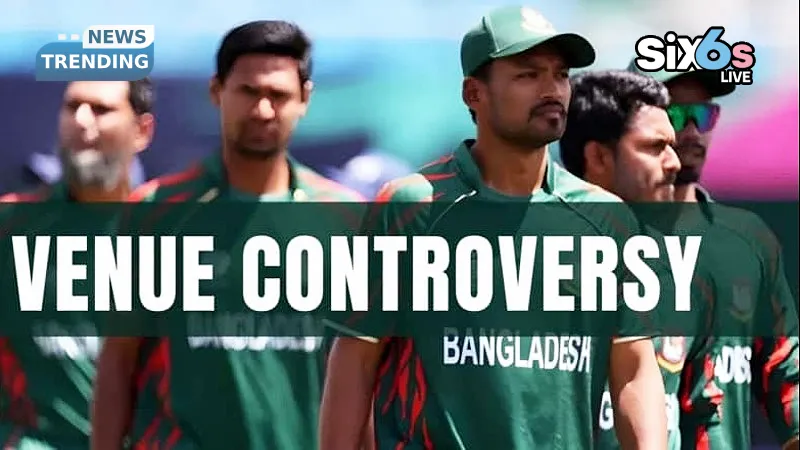
Politics, cricket has long held, should be kept on the other side of the rope at each end of the pitch. However, this ideal often gets interrupted by the physical presence of reality on the pitch in spike shoes. The decision by Bangladesh to boycott all of its T20 World Cup 2026 Matches in India does more than present an organizational problem; it quietly challenges the authority of the ICC to enforce its will when there are conflicts between security, national sovereignty, and scheduling.
When Player Safety Overrides Tournament Planning
Security is the basis for BCB’s stance. In an official capacity, the BCB Board states it will “not go to India” and continues to state its obligation to protect players, staff members, and officials; this is not merely performative rhetoric. The decision to remove Mustafizur from the IPL (a league that generally shields itself from political/geo-political issues) sent a clear message to Dhaka that outside influences can directly impact a player’s safety and long-term professional career.
The boards’ reliance on previous cricket history also lends credence to BCB’s cautious approach. The sudden withdrawal of New Zealand from Pakistan before a scheduled series due to security concerns prompted all cricket boards to realize that their decisions regarding travel, etc., should be based upon risk assessment, not the schedule of events, as with the BCB example cited here. By utilizing this precedent now (before booking flights), rather than after a crisis may arise, the BCB Board is attempting to ensure that no unnecessary risks are taken by their players.
A Test of ICC’s Practical Authority
The ICC responded by stating that the travel schedule has already been finalized; however, in the world of international sports, governance is hardly ever absolute. The ICC may be able to guide, encourage, and negotiate with member boards regarding player safety concerns, but it cannot force a sovereign board to put its players in harm’s way.
This is the reality of today’s cricket administration. The ICC’s authority in this regard is based on structure, not coercion. If BCB President Aminul Islam and other high-ranking BCB officials (Shakawath Hossain, Faruque Ahmed, Nazmul Abedin, and CEO Nizam Uddin Chowdhury) are all in agreement, the ICC will likely need to find ways to accommodate the Board rather than enforce its authority.
Why Sri Lanka Becomes the Diplomatic Middle Ground
The selection of Sri Lanka as an alternate location is not at random; Sri Lanka has been viewed throughout history as cricket’s “diplomatic Switzerland” (logistically viable and less political) and neutral in many ways. In times of unrest in Pakistan, Sri Lanka hosted a “home” series. For years, the UAE also performed the same role for teams that were unable to travel there due to conflict.
Scheduling difficulties and commercial complications arise from moving all of the home fixtures of one team. However, maintaining competitive balance far surpasses the potential problems of removing a team from competition. This is why the ICC says “that discussions will continue to explore possible solutions.”
The Clock Is the Real Opponent
In fact, Time has become the deciding factor in politics. “We don’t have too long,” said Vice-President Shakhawat Hossain bluntly. Fixtures will be locked up. Travel plans will be made. Sponsors will expect certainty. And the longer this goes on, the bigger the danger of either an eleventh-hour agreement or the complete reorganization of the group stages.
Asif Nazrul’s sports advisor comments to the media that Bangladesh “isn’t ready to go to India,” strengthening his stance. It is not a negotiating ploy to gain advantage, but rather a position based on local political accountability. Once a board takes that public position, retreating from it can cost them their reputation.
As a matter of historical precedent, this “adjustment” that will allow the World Cup to go forward under some form of compromise will be called a “logistical adjustment.” The teams for matches, the sponsors for the event, and all other interested parties will adjust their position in an effort to make the World Cup happen; however, the underlying implications of this situation (the fact that national boards of cricket are responsible for determining safe locations for their respective players) will continue to exist with or without the World Cup taking place. This is the nature of the world of international cricket today; thus, while it may be undesirable, it cannot be avoided.
Stay updated on the latest cricket news and exciting updates at Six6slive. Dive into our in-depth articles and analyses to connect with the action today!