
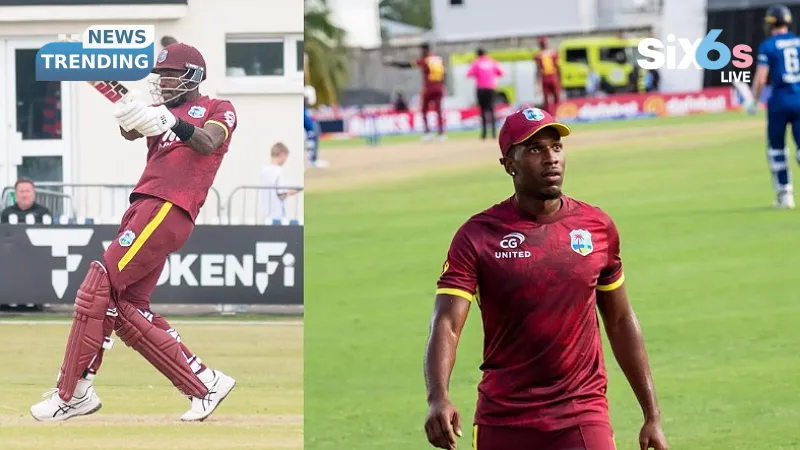
The West Indies have never been short of T20 swagger. However, the West Indies have been lacking something in recent years; it’s not a lack of raw power; rather, it is the ability to translate that raw power into repeatable tournament success through a greater sense of coherence. For this reason, the upcoming three-match series between the West Indies and Afghanistan at Dubai on January 19 is more than just a warm-up series. It will be an opportunity to test their identity under pressure.
Leadership Without the Comfort Blanket
King’s designation of Stand-in Captain is an example of practicality, not cosmetics. King had previously led the West Indies in T20I cricket (West Indies vs. South Africa at home) early in 2024; therefore, King’s designation indicates that there is no crisis in the team, but it does indicate that King will provide some level of continuity to the team. However, the “leadership” in this series is much more about the tone that King establishes rather than what strategies he uses or how he utilizes players. With Shai Hope being absent from the lineup, King must now use his influence to find a balance between the historical aggressive nature of West Indian teams and the discipline required on slow pitches.
Rested Stars, Real Selection Pressure
While there is no official reason given for why Powell, Holder, and Shepherd were left out, the fact that they were is a result of a strategic decision as well as a workload management decision; this opens up selection opportunities. Historically, West Indies teams have used a ‘star system,’ but in today’s era of T20 cricket, those that use an interchangeable team concept tend to be the ones that achieve the most success. While Matthew Forde, Justin Greaves, and Ramon Simmonds may not be the ‘stars’, the fact remains that they provide the type of role players (batting depth, seam bowling options, additional fielding) needed to assess whether or not they can assist the team in terms of adding balance and providing coverage in the World Cup.
Quentin Sampson and the Cost of Opportunity
Every tournament season needs at least one player who will make you think again about your team for the next tournament. In 2026, for the West Indies, that player could be Quentin Sampson. Sampson was named the 2025 Caribbean Premier League’s Breakout Player and now gets called up to the national team for the first time (in place of Powell), and this is not just a token rotational move but rather an actual tryout. Historically, the West Indies have had trouble converting their success in domestic T-20 cricket to consistent performances internationally. Sampson simply needs to take his impressive statistics from the CPL and show they can translate them to a difficult environment with a spin-heavy bowling lineup and not get impatient.
Fitness, Fragility, and the Fast-Bowling Dilemma
Alazarri Joseph has been ruled out for a third consecutive game with a hamstring strain, and Evin Lewis and Shamar Joseph have returned from injury. This combination alone speaks volumes. The fast bowling legacy is what makes up West Indies’ strength, but it does not make for much success when competing in Twenty20 Cricket (T20) on slow, abrasive surfaces where raw pace lacks control and therefore is little more than ornamental. Therefore, Jayden Seals, Shamar Joseph, and Shamar Springer will be evaluated based on execution as opposed to pace – how well they hit their marks, the variation of back-of-the-hand type deliveries, and their ability to contain batsmen in the final overs. The West Indies are being very cautious with Alazarri’s fitness and appear to want to know if their potential World Cup attacking unit will be both hostile and frugal. History would suggest that in Asia, you can only have one or the other.
Stay updated on the latest cricket news and exciting updates at Six6slive. Dive into our in-depth articles and analyses to connect with the action today!