
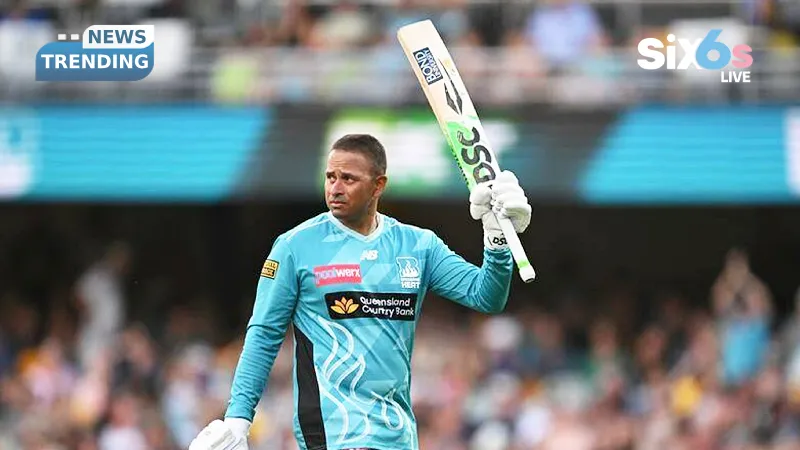
Cricket can be quite odd when it comes to the way that stories are written: you hang up your whites after being called upon to play for your country, then the very next thing is that you find yourself in T20 action again as captain of a team which wins with you making 78 from 48 deliveries in the process of pushing your team further up the ladder in terms of BBL standings. This was what Usman Khawaja managed to do for Brisbane Heat; he changed an otherwise run-of-the-mill BBL campaign (a campaign that could have easily been spent in mid-table mediocrity) into a solid push up the BBL standings.
Jack Wildermuth: The Unsung Catalyst
Wildermuth showed himself by smashing a blazing 39 off 15 deliveries. In his 39 runs, he scored four fours, hit three massive sixes, and gave the Heat an early momentum advantage in the game. Wildermuth’s 260 strike-rate did not simply show off; it forced Thunder to be reactive in its early batting plan and provided an example of how to develop aggressive left-handed batting combinations.
Wildermuth’s 15-ball 39 was more than a cameo; it demonstrated how T-20 cricket is rewarded when batters are bold and confident in their approach. When Khawaja came to bat after Wildermuth, he had the foundation to increase his run-scoring and have the upper hand on the rest of the batting order, illustrating that, even with an elite batting line-up, a timely cameo from an unheralded player can alter the complexion of a chase.
The Left-Handed Onslaught: Khawaja and Renshaw
Khawaja and Matt Renshaw’s 93-run partnership showed the art of T20 geometry in action. Whether bowling to a left-handed batter, a right-handed batter, a spinner, or a fast bowler, every combination had the same problem: can you keep them contained, or will they rip you apart? The partnership took place in just 54 deliveries, showing how to rotate strikes at a high level of efficiency while still hunting boundaries as efficiently as possible.
In history, left-hand batting partnerships in T20 chases have been a source of strategic problems for teams. Heat did this one perfectly. Khawaja was the steady hand that timed his shots well and placed them where he wanted. Renshaw provided the perfect complement by continuing to move the score along aggressively. A good T20 chase has a great balance of aggressive play and defensive control. Heat played a textbook T20 chase.
Thunder’s Fragile Middle Order
Sydney Thunder’s batting performance exemplified an ongoing trend for their reliance on one or two high-scoring batsmen. David Warner scored 82, which is excellent, but it put a great deal of pressure on him due to a knee blow that left him struggling and therefore made his side vulnerable. Sam Billings’ quadriceps injury to the Thunder’s batting lineup further reduced their depth, highlighting the extent to which T20 fortunes are determined by both fitness and form.
The Sydney Thunder were able to score 50 runs in the last five overs to mount a late charge but ultimately fell short of victory. The Sydney Thunder’s lack of ability to create long-lasting batting partnerships with Warner and Billings reflects trends seen throughout past unsuccessful BBL seasons. In most instances, teams have had successful batting performances early in the season but have lacked a stable batting order in the middle of the season, which has contributed to failure.
Heat has a well-defined route ahead: maintain their current level of performance, protect player injuries, and continue to grow the emerging players of Wildermuth and Bryant. Although the influence of Usman Khawaja will be felt immediately, whether or not he helps Brisbane turn the late-season momentum into a viable playoff run will depend on the overall synergy of the entire batting order.
Stay updated on the latest cricket news and exciting updates at Six6slive. Dive into our in-depth articles and analyses to connect with the action today!