
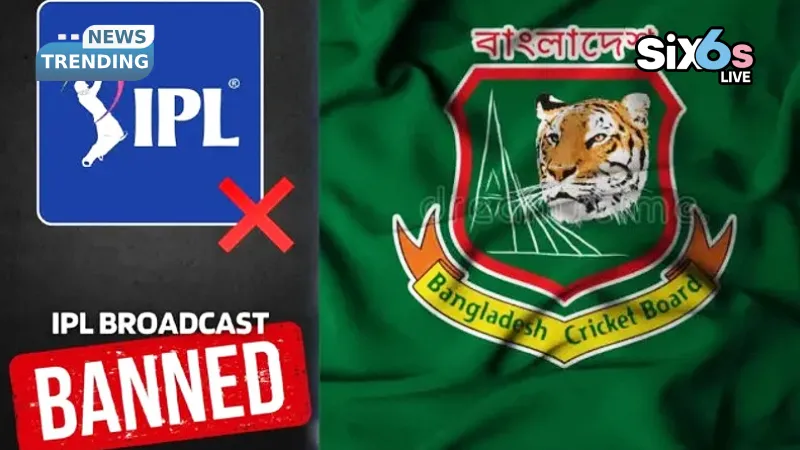
Bangladesh’s primary source of relief from its many frustrations is Cricket. It is in the sport where it is common for frustration to melt away with the cover drive and the left-arm cutter. But this week, that valve was closed by Bangladesh. On Tuesday night, Bangladesh announced via an administrative announcement that the country would cease broadcasting the Indian Premier League (IPL) throughout the nation. This would turn a team selection choice into a full-fledged geopolitical cricket moment.
When Selection Becomes Symbolism
Although franchises can choose or not choose whom they want on paper, Mustafizur’s is not an isolated instance. His exclusion from the Bangladesh squad, after being the country’s best export-quality bowler since his emergence in 2015 (with the IPL being a prime example of his quality as a bowler who consistently delivered much more than the ratio between hype and wickets), transformed what appeared to be simply a cricket decision into what was perceived as a national slight and not merely a cricket analytical one.
That is why the language used by the Ministry in its notification to explain the exclusion is important; the notification stated there was “no reasonable justification” for the exclusion. The language used here is important because this was not based on whether Mustafizur had the right form chart, or even if he could have been acquired at the right price through the auction process. It was about Mustafizur’s dignity and how the decision would be perceived.
Broadcast Rights as a Power Lever
Banning all IPL coverage isn’t a symbolic slap at Indian Cricket – it’s a clear message about both money and culture. In terms of viewership, the IPL draws more eyeballs than the Indian bilateral home cricket series. The Ministry of Information & Broadcasting has therefore used media rights as a tool for diplomacy by taking all IPL games and related programming off the air “for now.”
The ministry has never acted like this before (with one exception), so this is clearly a message to the cricket world that they believe the business side of cricket is very vulnerable and can be influenced from outside India’s borders.
The BCB’s Security Argument, Reframed
In announcing the BCB’s move for a change of venue of T20 World Cup matches from India on grounds of “Security”, the timing of the announcement speaks louder than the reasons themselves. In this case, “Security” serves as a euphemism for a strategic language (neutral, defensible, and ICC-compliant) that provides an acceptable reason to express dissent.
Cricket history has many examples of “Security” being used as a cover-up for other political or administrative conflicts. What is different here is that it took Bangladesh very little time to go from “Concerned” to taking united action.
Franchise Cricket Meets National Identity
Regardless of whether or not the last week’s impasse is resolved via low key back door diplomacy involving either the government(s), and/or the players, or becomes another prolonged stalemate, one thing has been made abundantly clear: International Cricketers’ actions cannot be viewed as being completely removed from the political landscape of the country whose icons they represent. A player’s actions have consequences beyond the confines of franchise cricket.
Cricket, historically, reflects existing power structures. What happened on TV and is now being broadcast less often than we might like was a reflection of that; now we see them out in the open.
Stay updated on the latest cricket news and exciting updates at Six6slive. Dive into our in-depth articles and analyses to connect with the action today!