
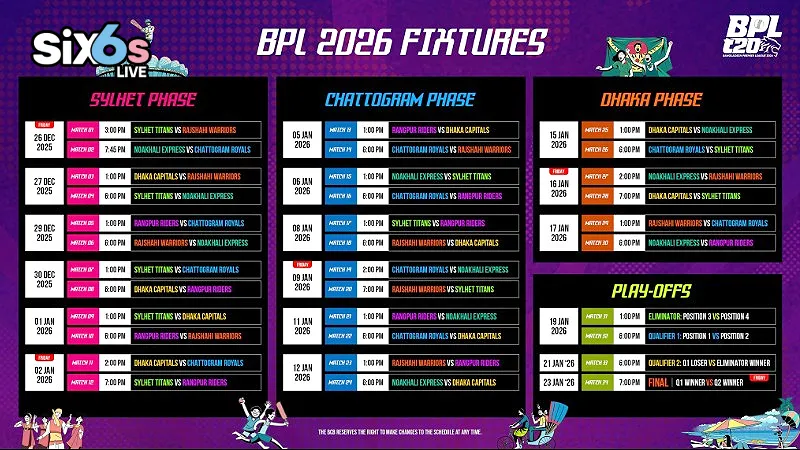
The Bangladesh Premier League (BPL) 2025-26 has made an unfortunate discovery about the importance of logistics when it comes to deciding the outcome of a tournament; there’s an odd paradox at work in Twenty20 (T20) cricket – while we’re consumed with the idea of big hitters and fast bowlers during the latter stages of a match, ultimately, who wins a competition can depend on things like how teams get from point A to point B. Originally, the Bangladesh Premier League was going to be played out across three venues before being condensed to a two-city dash after the organizers took Chattagram out of the equation and added the responsibility of playing more games than had been expected to Sylhet.
Logistics Over Romance
The decision to omit Chattogram from this year’s Bangladesh Premier League (BPL) is a decision of governance, rather than a cricketing decision disguised as such. The Bangladesh Cricket Board (BCB) has been quite frank about the reason for omitting Chattogram from the competition: a two-day gap that was created due to a tragic event at the national level made the BCB have to reconsider the teams and the travel schedules. The best way for them to do this was to cut down on the number of travel days; while saving just two travel days does not appear to be a big deal, in a busy and tight T20 schedule, the amount of time it will give the players to rest, avoid injuries, and prepare better for their matches could make a difference. While the administrative aspect of this decision is sensible and pragmatic, it is difficult to see how the fans of Chattogram are being treated fairly.
Sylhet’s Pitch Dilemma
Cricket’s true anxieties lie below Sylhet’s lush green grass. Hosting for an extended period of time creates very valid worries regarding “pitch fatigue,” which is especially concerning in a format where poorly performing pitches are penalized. Historical data suggests that when Sylhet pitches become overworked, they will become slower and “grippier” and favor bowlers with high cutters and spinners rather than batsmen who hit clean balls. While the BCB’s decision to rotate four pitches as opposed to two is a good idea, it is far from foolproof. Rotating pitches does help; however, it is impossible to fully replace the excitement of a venue that is being utilized in short spurts.
Who Actually Gains an Edge
The bowlers who can be effective with an even slower ball, finger spinners, slower ball bowlers that come from behind the hand, and batsmen who can nudge at strike rather than try to hit the ball as far as they can are going to be very happy if the pitches become slower. Any team that can build its lineup around batting for time rather than blasting a huge amount of runs may find the conditions at Sylhet to be much harder to play in than those at Mirpur, which means that the teams that have the best balance within their squads (as opposed to the most talented) will likely be the ones that are the most competitive.
Mirpur: The Reset Button
The switch to the Sher-e-Bangla National Cricket Stadium from January 15 creates an effective competitive reset. The familiarity with Mirpur will create a level playing field for the playoff-bound teams that have played here before, including understanding its idiosyncrasies (bouncy wickets, larger boundaries, lower first innings average than flat tracks). The scheduling of the Eliminator and Qualifier 1 on January 19 as back-to-back games will also increase the pressure, thereby making it the ability to clearly identify tactics to survive.
Stay updated on the latest cricket news and exciting updates at Six6slive. Dive into our in-depth articles and analyses to connect with the action today!