
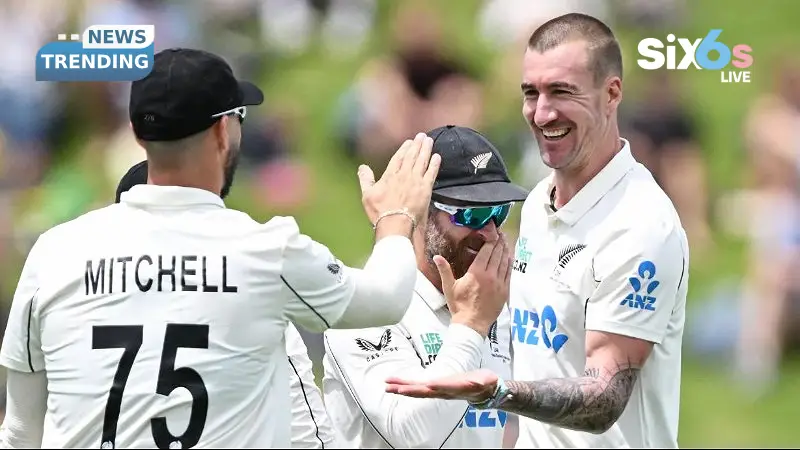
Tickner will miss the second Test against India in Christchurch, and the bigger worry for New Zealand is the pattern. A right hamstring problem picked up at training during the Wellington Test week has ruled him out of the match that begins on November 27, and it arrives barely a fortnight after a blow to the helmet cost him two ODIs. New Zealand Cricket confirmed the news on November 23. Mitchell Santner is missing too, which leaves the hosts short of experience.
Hamstring Trouble Ends His Christchurch Hopes
The damage came away from match play. Tickner felt his right hamstring go during a practice session in the build-up to Wellington, and it proved serious enough to remove him from the next Test altogether. The plan is to assess him again once the squad reaches Christchurch, where the medical team will decide the next step. Nobody has put a date on his return, and that silence suggests the selectors are already planning a Test without him.
The timing hurts. New Zealand confirmed the call four days before the toss, so there was little room to test him in the nets or wait on a late fitness check. Santner is also out, which means two experienced names have dropped off the sheet in the same week. For a side trying to beat India, losing a seamer and a spinning all-rounder at once forces a rethink of the whole balance.
Blair Tickner Injury India Test
This hamstring is the second thing to stop Tickner inside a month. On November 7, in the second ODI at Wellington, a delivery from Kamboj struck him on the helmet during the 41st over. He could not carry on, and Fisher came into the game as his concussion substitute. That swap looked minor at the time, yet it set up the selection call New Zealand have just made.
Tickner passed his checks after that blow, but the rules gave him no shortcut back. The ICC applies a seven-day stand-down for concussion, counted from the day of the match, so he sat out the third and fourth ODIs while Clarke was called up as cover. Now a soft-tissue issue has taken him out again, this time with no fixed date for a return. Two unrelated problems have now cost him matches in two formats within the same month.
Fisher Steps Into the Fourteen-Man Squad
Fisher is the man drafted into the 14-man group, and his red-ball record is thin. He has played one Test, against Zimbabwe in Bulawayo, a match that began on August 7, 2025. He took a wicket in each innings there, finishing with 1/16 and 1/22. That is a tidy enough return for a debutant, but it came against weaker batting than India will put in front of him.
His white-ball form over the past fortnight makes a stronger case. Fisher picked up 3/31 in the fourth ODI on November 13, then followed it with 2/28 in the fifth. Five wickets across two games, at a low price, is the reason he is the first name the selectors reached for. There is an odd symmetry here too, because he is replacing Tickner for the second time this month.
A Thin Seam Group Faces Christchurch
The draw in Wellington showed how much work the attack already faces. New Zealand made 368 and 239/5, but the bowlers sent down 166 overs between them and leaked 704 runs for nine wickets, so India were rarely under pressure for long. Duffy went for 201 runs in 33 overs and took one wicket. Phillips was the most successful bowler with 3/154, while Ravindra chipped in with two, so the part-time spin did more damage than the quicks.
Fitness elsewhere makes the picture worse. Henry played in Wellington but is carrying a quad tear that the ICC put at up to two weeks, and his place for Christchurch has not been confirmed. Ferguson has a low-grade right calf tear that ruled him out of the remaining ODIs, with no word yet on his Test readiness. If Henry cannot get through, the Blair Tickner injury India Test problem turns into a seam shortage, and Fisher could end up sharing the new ball on day one.