
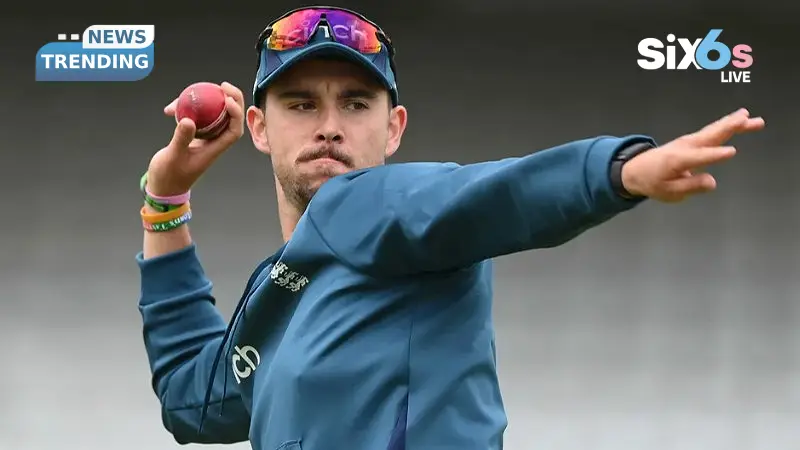
Nobody has been named to replace Josh Tongue, so England’s seam workload in Australia falls on the 15 players already in the ODI squad. Tongue was ruled out on 7 November with a left big toe problem and is going back to Britain to have the foot examined again, with no timeline for his comeback. Archer, Atkinson and Overton look best placed to absorb his overs, with the first game in Perth on 13 November. Brook’s side now faces three games in six days without him.
Toe Problem Ends a Tour Before It Starts
The fast bowler was withdrawn from England’s limited-overs trip on 7 November because of damage to his left big toe. He will go home to have the toe examined, and there is no recovery date available. The problem is believed to have started during the Pakistan tri-series, when he sat out the closing pair of games. Older 16-man squad listings also carried his name, which shows he was part of the plan until now.
No replacement has been named, so the squad stays at 15 under Brook, with Archer, Atkinson, Baker, Crocombe, Curran and Overton as the seam options. Rashid and Dawson provide spin, while Bethell and Jacks add part-time overs. That mix gives the captain choices, but few of them are proven against Australian batters in white-ball cricket. Their combined experience in the format, Archer apart, is limited, and the selectors have no reinforcement on the plane.
Australia ODI series Josh Tongue injury Fallout for England
Atkinson has the strongest claim for a bigger role. He took 2/35 against Pakistan on 20 October and followed it with 2/62 off nine overs five days later, showing he can take wickets even when the runs flow. Overton took 3/43 off 10 overs on 25 October, the best figures among England’s seamers that day, and both look like natural fits for Tongue’s slot as hard-length bowlers. Overton’s 3/43 came on the same day as Atkinson’s 2/62, so the pair offer contrasting profiles, one economical and one aggressive.
Baker took 3/65 on 20 October, Curran went wicketless for 32 off eight overs on 25 October, and Crocombe made his ODI debut with 1/57 from 6.1 overs. Curran’s 0/32 off eight overs was frugal rather than poor, an economy of 4.00. Archer sat out the tri-series for rest but claimed 3/34 in a tour game in Western Australia, which England won by 92 runs. His ODI form is harder to judge, since the data is thin, yet the pace he brings is unmatched in the squad.
Pakistan Results Reveal Depth Concerns
England lost both ODIs to Pakistan, the first by 87 runs when they were bowled out for 215 chasing 302/9, and the second by one wicket after posting 241 against a target of 243/9. Crocombe’s 1/57 and Atkinson’s 2/62 on 25 October show how expensive a single bad spell can be, since both conceded more than six runs per over.
Depth is the real question here. With Archer back, the attack has real pace, but the support cast has little experience in these conditions, and Crocombe has just one ODI cap. If the senior seamers are asked to bowl heavy spells in all three games, workload management could become as important as tactics. Archer’s return to the XI would immediately raise the ceiling of the attack, but it cannot fix the shortage of experienced support.
Schedule and History Raise the Stakes
England open in Perth on 13 November, travel to Adelaide on 15 November, and finish at Bellerive in Hobart on 18 November. All three games start at 2:30 pm AEDT under lights. There is little time to settle a new bowling order, with three matches inside six days. The Bellerive finale offers the only chance to adjust after seeing two games of Australian conditions.
History is not kind to the tourists. From 1971 to 2022, England played 74 ODIs in Australia, winning 25, losing 48 and finishing one without a result. That backdrop makes the Australia ODI series Josh Tongue’s injury setback a bigger test of squad depth than any single absence would suggest. Of those 74 matches, England lost nearly two-thirds, so a patched-up attack faces a historical headwind.