
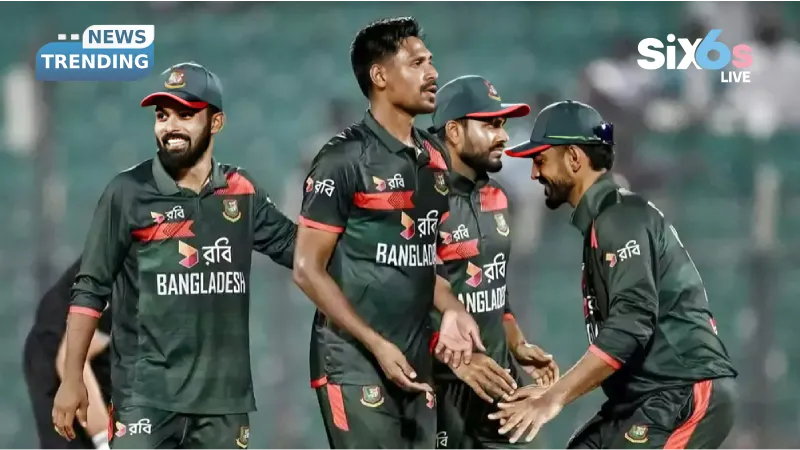
Bangladesh are out of the competition after a seven-wicket loss to Afghanistan in Sharjah, their second heavy defeat in five days. The result confirms a pattern that has followed this ODI side for roughly a year and a half: a shaky start, a top-order collapse and a recovery that arrives too late. Towhid Hridoy, leading the team in an acting role, admitted the players cannot turn talk into results. Five straight ODI losses now frame the next assignment in South Africa, where the same questions will return.
A Collapse That Decided the Match
Winning the toss and batting first looked sensible until the seventh over, when the scoreboard read 28 for 4. Tanzid made 1, Soumya fell for 0, Shanto managed 15, and Hridoy departed for 0, so the top four had gone before the innings found any shape. Rashid Khan finished with 4 for 31, while Yamin Ahmadzai and Azmatullah Omarzai took two wickets each for 21 and 27 runs. The last five wickets fell for just 39, and Bangladesh were bowled out for 160 in 41.2 overs.
Afghanistan needed only 35.3 overs to reach 161 for 3, which left 87 balls unused. Rahmat Shah stayed unbeaten on 67 from 90 deliveries and never looked hurried. Taskin took two for 36, yet a total that small gave the attack nothing to defend. A margin of seven wickets describes the gap between the sides more honestly than the toss ever could.
Bangladesh tri-series 2026 exit
The damage began four days earlier in Abu Dhabi, where Zimbabwe posted 271 for 8, and Bangladesh replied with 172 all out in 33.4 overs. The 99-run defeat was strange in shape, because the openers had raced to 42 without loss after six overs before everything unravelled. Tanzid scored 46, Saif 26 and Rishad 23, but Hridoy, Shanto and Mosaddek were all given out leg before, which points to a technique problem as much as bad luck. Hridoy made 13 and Soumya 9, so the batters at the top and in the middle both failed to rescue the innings.
Two defeats in five days therefore ended the campaign, and both followed the same script of a decent platform followed by wickets in clusters. In neither game did the batters build a partnership big enough to repair the first setback. That repeated failure to rebuild matters more than the raw result of either match.
Emon and Saif Offered Some Hope
The one positive thread was the middle order, where Emon returned in place of the injured Litton Das and produced a career-best 70 from 96 balls, with five fours and two sixes. It was his first ODI in more than a year and his second fifty in four appearances. Rashid eventually trapped him leg before, ending a stand of 93 for the fifth wicket that had started from 28 for 4. Without that stand, the total would have been far smaller.
Saif Hassan was the partner in that rescue, scoring 41 from 82 deliveries before Nabi removed him with the score at 121 for 5. His maiden ODI fifty came against West Indies on 23 October 2025, when he made 80 from 72, so the ability is not in doubt. Two batters settling in for long periods is exactly the resource this order has lacked, and selectors can build around it.
South Africa Will Test This Group
Hridoy was blunt after the elimination, saying the group could not match its words with its actions, and he linked the problem to poor away form stretching back around eighteen months. The numbers support him: five straight ODI defeats and just two wins in sixteen away ODIs across two years. Nobody can call that a short bad patch. Those figures turn a rough week into a trend.
The next chance to respond comes in South Africa, with ODIs at Buffalo Park in East London on 1 December, St George’s Park in Gqeberha on 4 December and Newlands in Cape Town on 7 December. Fresh conditions and stronger opposition will punish the same early collapses, so the top order must fix them first. If the Bangladesh tri-series 2026 exit teaches anything, it is that the middle order cannot keep covering for the first six overs.
Stay updated on the latest cricket news and exciting updates at Six6slive. Dive into our in-depth articles and analyses to connect with the action today!