
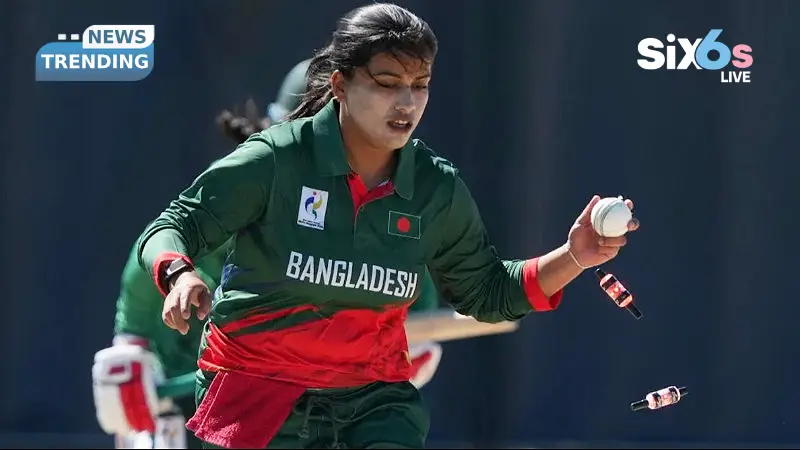
Nothing changes in the ODI setup yet, because Nigar Sultana Joty remains captain of that side while Nahida Akter takes charge of the T20I team for a year. Sobhana Mostary will serve as her deputy, and the decision was announced on 18 October. That makes the shift a short-term experiment, not a permanent reshuffle. It arrives right after a 0-3 ODI defeat in Australia, the last game played on 14 October, and a review is planned ahead of the 2028 T20 World Cup.
A One-Year Mandate With Review
The chairman of the women’s wing, Rafiqul Islam Babu, explained that the board decided to give Nahida the T20I captaincy and that the role runs for twelve months. The appointment begins at the Emerging Nations Trophy in Thailand, so there is almost no gap between the announcement and the first assignment. A fixed term also signals that nothing is permanent. For a team still processing a heavy series loss, that speed leaves very little time to rebuild confidence.
The review before the 2028 T20 World Cup gives the arrangement a clear exit point. If results improve, the board can extend her stay with evidence behind it, and if they do not, the leadership can be reshuffled without embarrassment. Few boards build that safety valve into a captaincy, which suggests the selectors want flexibility more than a long-term answer. Whether an extension follows will probably hinge on results over the coming months rather than on any single tournament.
Nahida Akter, Bangladesh women’s T20I captain
Nahida brings a long career to the job. The latest figures show 65 ODIs with 81 wickets and 113 T20Is with 132 wickets, which makes her one of the most experienced bowlers in the squad. Older records list lower totals, but they are stale, and the newer numbers are the ones that reflect her workload. Those totals give her credibility with the bowlers she will be setting fields for.
She has also been in the leadership group for some time, serving as deputy to Joty since 2022. Her record in that deputy role is not documented, so there is no tally of results to judge her by. What the appointment does show is that the board trusts a familiar, long-serving player over an outsider. Mostary as vice-captain adds a second voice to the group and a ready successor if circumstances change.
Joty’s Numbers Explain the Change
Joty leaves the shortest format with a modest ledger. In roughly 80 T20Is under her leadership, Bangladesh won 32, which is well short of half. In the 50-over game, the side won 15 of 47, and the recent 0-3 loss in Australia underlined how hard the results have been. Seen from that angle, handing the shorter format to a fresh voice looks like a reasonable reset rather than a punishment.
Her own batting is part of the picture. Joty made 56 runs in four matches at the 2026 Asia Cup, and her career T20I tally stands at an average of 27.30 from 2,048 runs across 103 matches. She spoke about having a lot more to give as a batter and as a player, and she wished Nahida well in the new role. The two captains now hold separate territories, and the board will watch how each responds.
ODI Leadership Stays Where It Is
The decision splits the captaincy by format, and Joty remains the ODI captain. That keeps continuity in the longer white-ball game, where she has led 47 matches, even though the results have not matched the experience. Her ODI record reads 15 wins and 26 defeats, with six more games ending without a result, so the pressure on that side will not ease. Nahida will not lead the ODI side unless the board chooses to change course later.
The split also hands Joty room to focus on her batting without the weight of both teams. If she recovers form, the board gains a stronger player and a stable ODI captain. Everything now depends on how the Nahida Akter Bangladesh women’s T20I captain handles the first assignment in Thailand and whether the review in 2028 points toward a wider handover. Even then, the ODI side will wait for its own verdict after the Australia series.