
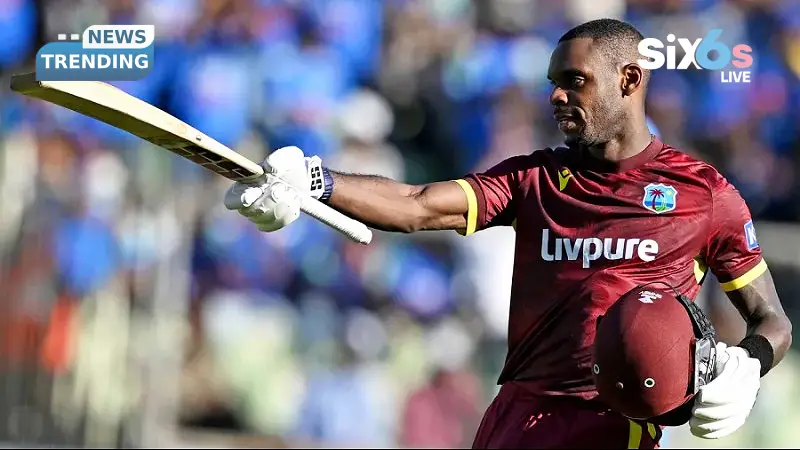
West Indies lose their centurion for the second ODI, and the batting order has to be rebuilt on the run. Justin Greaves hurt his calf during a maiden hundred at Thiruvananthapuram, and the damage rules him out of the Guwahati game. Jewel Andrew is expected to open alongside John Campbell, with Rutherford returning to the middle order. India lead 1-0, so the visitors cannot afford a slow start with the new ball. Here is how the reshuffle looks, who benefits, and what it risks.
Justin Greaves calf injury West Indies second ODI
The scoreboard from Thiruvananthapuram hid the real story. Greaves finished on 101 off 108, his maiden ODI century, yet he struggled running between wickets and needed the physio several times. Kuldeep Yadav eventually dismissed him, and he did not take the field when India chased. That absence in the field was the early warning. A batter who needs treatment repeatedly mid-innings and then sits out the second half of the match is carrying something more than a knock.
Now he’s out of the second game, the third ODI at New Chandigarh on 3 Oct is doubtful, and he isn’t in the T20I squad that starts on 6 Oct. No scan result or recovery timeline has surfaced, which leaves West Indies planning in the dark. His output since 2025 makes the loss heavier. Greaves has piled up 528 runs in 19 innings and added 7 wickets, so West Indies lose a batter and a bowling option together.
Andrew and Campbell Face a Testing Start
Jewel Andrew is expected to open with John Campbell, and the numbers behind that call are thin. Andrew has played 3 ODIs and scored 8 runs at an average of 4.00, with a highest score of 8. His last ODI came on 1 Jun 2025 against England.
Eight runs from three innings is not a body of work. It’s a lot to ask of a player with so little ODI time when India’s bowlers have the new ball in hand and the series on their side. One early wicket and the visitors are chasing the game again.
That puts extra weight on Campbell. The partner beside a rusty opener has to do the early thinking for both, soaking up the first spell and keeping the scoreboard moving so Andrew can find a rhythm. If Campbell falls first, the reshuffle unravels before the middle order has even padded up.
Rutherford Anchors a Rebuilt Middle Order
Rutherford returns to the middle order after missing the first ODI for personal reasons, and his record is the strongest card in this reshuffle. He has 743 runs from 22 ODIs at an average of 43.70, with one hundred, seven fifties, and a highest score of 113.
His last ODI was on 22 Nov 2025 against New Zealand, so he comes back after a break. Still, an average above 43 gives West Indies the one reliable number in a shuffled lineup. If he settles early, the middle overs stop looking like a gamble.
Seven fifties against a single hundred also tells you what kind of batter he is. He builds, he rarely collapses, and he turns starts into scores. That’s exactly the profile a side needs when the top of the order is untested, and the chase or the target is already heavy.
India Lead and the Pressure Builds
India won the first ODI by 8 wickets, chasing West Indies’ 295/7 in 41.4 overs. That ease shows how big a total the visitors need now. A score of 295 was not enough even with a Greaves hundred in it, so the replacements must find more.
Finishing the chase with more than eight overs to spare also means India never had to take a risk. West Indies have to force that situation, and they have to do it without the one batter who made the biggest score of the first game.
West Indies must win both remaining matches to take the series, and the second ODI at Barsapara Stadium in Guwahati on Wed 30 Sep is the first of those. However, the scan shows that Justin Greaves’ calf injury and the West Indies second ODI selection puzzle will shape whether this series survives past Guwahati.