
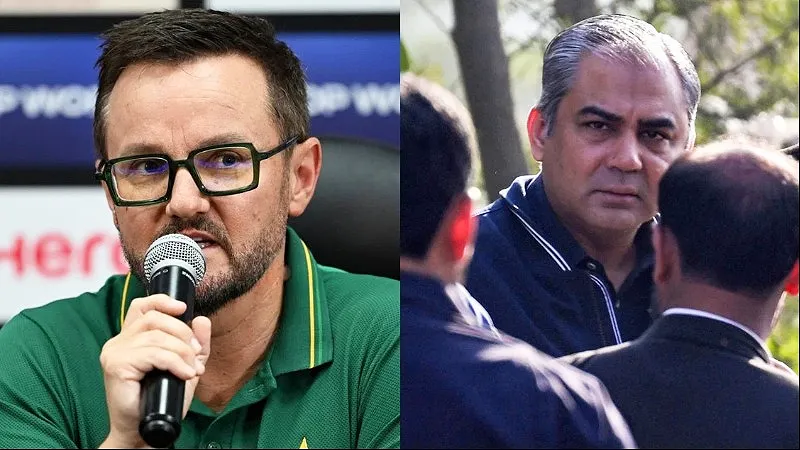
Hesson himself gave the clearest answer after Edgbaston: the call rests with Pakistan’s board and its selectors, not with him. He has ruled nothing out and ruled nothing in, saying only that he will discuss the Test job once the Asian Games are behind him. That leaves the PCB holding a decision it has delayed six times in three years, and it comes with a hard deadline, since Sri Lanka’s November tour arrives whether or not a permanent coach is in place by then.
Pakistan Test coach Mike Hesson’s decision
In the same press conference, Hesson turned down another opportunity entirely. His agent had already fielded an approach from England over their vacant Test job, left open after Brendon McCullum’s departure, and Hesson chose to stay put rather than pursue it, citing his existing commitment to Pakistan’s white-ball side. England moved on and appointed Stephen Fleming instead.
That loyalty says something about how Hesson views his current role, even while the red-ball job stays unresolved. He took interim charge of the Test side less than two weeks before that Edgbaston match, stepping in only after Sarfaraz Ahmed was sacked following the Lord’s defeat. One match in charge ended in an eight-wicket loss, Pakistan’s third straight defeat of the series.
PCB’s Selection Process Behind Closed Doors
Behind the scenes, the board’s plan looks straightforward on paper. A source close to the board says PCB wants to keep Hesson as permanent red-ball coach if he agrees to take it on, and if he doesn’t, a replacement will be named before the home series against Sri Lanka in November. No public statement has confirmed either path yet.
Around that same decision, PCB is quietly reshaping who makes selection calls in the first place. Senior selector Aqib Javed is reportedly being moved off the panel, while Misbah-ul-Haq has offered to step aside on his own. Both changes are expected to surface once the England tour officially concludes, alongside notices already sent demanding an explanation for recent squad picks.
A Congested Season Still Needs Answers
Whatever happens with the Test role, Hesson already has one assignment locked in. He leads the white-ball squad at the Asian Games in Japan from late September, with Sahibzada Farhan as captain, and that tournament is what he has repeatedly pointed to as his immediate priority.
After that comes a genuinely packed home season: three T20Is against Sri Lanka in Rawalpindi in October, a seven-match ODI tri-series also involving England later that month, and two home Tests against Sri Lanka in November with dates still unconfirmed. Whoever is coaching the red-ball side by then inherits a schedule with almost no room to ease in gently.
The chaos around the role isn’t new. Pakistan have cycled through six different Test arrangements in just over three years, from Jason Gillespie to Aqib Javed as caretaker, then Azhar Mahmood, Sarfaraz Ahmed, and now Hesson on an interim basis, averaging a change roughly every seven months.
The Interim Appointee’s Numbers So Far
Judged purely on the white-ball numbers, the case for keeping Hesson is easy to make. Pakistan won a tri-series in Sharjah against Afghanistan, split results across the Caribbean and the United States, and reached the Super 8 stage of the T20 World Cup before a Harry Brook century ended their run. Hesson has described the turnaround in blunt terms, saying the side went from winning roughly one in five matches to nearer three in four across his time in charge.
The red-ball side of the ledger is thinner by comparison, just one Test so far, and it was not a flattering audition. Pakistan were bowled out for 133 in the first innings at Edgbaston, their joint-lowest total in thirteen years, before a second-innings recovery to 449 was not enough to avoid an eight-wicket defeat.
That split record is exactly why the Pakistan Test coach Mike Hesson’s decision won’t be rushed. The board can point to a genuine white-ball turnaround as a reason to trust him, while a single chaotic Test tells selectors almost nothing either way. Until the Asian Games are done and those promised conversations with selectors actually happen, Pakistan’s Test setup stays in limbo, run by a coach who insists the decision was never his to make alone.