
Four captains sent the same message within twenty-four hours: cricket’s redesigned 2027 World Cup format shrinks opportunity at the exact moment football proved expanding it works. The International Cricket Council confirmed a new Super Series elimination stage that removes two of the tournament’s lowest-ranked qualifiers before the main event even starts. Scott Edwards, Gerhard Erasmus, Richie Berrington and Paul Stirling all criticised the change within a day of the Edinburgh announcement, holding up the 48-team FIFA World Cup as proof that bigger fields grow a sport rather than shrink it.
Governing Body Unveils New Elimination Stage
The International Cricket Council announced the shake-up on July 16, 2026, at its Annual Conference in Edinburgh, four months after a different 14-team structure had already been signed off. That earlier plan split all 14 sides into two groups of seven, guaranteeing every team at least six group matches before a Super Six stage decided the semi-finalists, a structure the ICC had defended as recently as March.
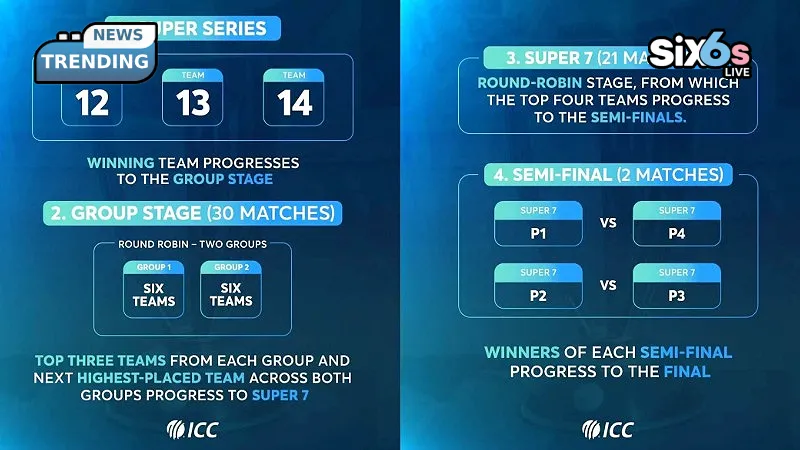
The new blueprint scraps that guarantee. Stage one, the Super Series, throws the three lowest-ranked qualifiers into a two-match round robin with only the winner surviving. Stage two splits the remaining eleven teams plus that survivor into two groups of six, playing five matches apiece, before a seven-team Super 7 round robin decides the semi-final line-up. Ten sides qualify automatically through co-host status or ODI ranking, with four more coming through a global qualifier event expected in December 2026 or January 2027. The ICC called it a format built to produce a more compelling tournament while still giving emerging nations a route to the biggest stage.
ICC ODI World Cup 2027 format associate captains
Scott Edwards, captain of the Netherlands, was first to respond, calling the timing of the change incredibly disappointing given the years of planning nations put into qualification. He argued the governing body talks about growing the game globally while making decisions that make it harder for developing nations to test themselves against the best sides in the world.
Namibia’s Gerhard Erasmus described World Cup qualification as something entire careers get built around, and said Associate nations accept they must earn their place but still expect that earning it means a genuine chance to compete once they arrive. Scotland’s Richie Berrington went further, saying players do not expect to make every call but should be consulted on decisions that reshape their careers, while World Cricketers Association chief executive Tom Moffat accused the governing body of failing on transparency, consultation and global growth all at once.
Opportunity Has Shrunk Since 2015
The complaint lands against a backdrop of shrinking access. Fourteen teams featured at the 2015 World Cup, and every one of them, Associate or Full Member, played a minimum of six group games. Scotland, Afghanistan, the UAE and co-host Ireland all got that guarantee, four Associate nations sharing the same stage as the game’s biggest names.
By 2019 the field had been cut to ten, and no genuine Associate side qualified at all. Netherlands broke through in 2023 as the sole Associate involved, beating South Africa and Bangladesh once they got there. Under the new Super Series, the 12th to 14th ranked qualifiers, the exact bracket where Ireland currently sits, would face each other in just two matches, with two of three eliminated before the tournament most fans recognise even begins.
Football’s Bigger Tent Argument
Ireland’s Paul Stirling made the comparison explicit, pointing to football’s 48-team World Cup as evidence of what an expanded approach delivers for the smaller nations chasing it. That tournament grew from 32 teams and 64 matches to 48 teams and 104 matches, with twelve groups of four sending the top two plus the eight best third-place sides into a new round of 32.
Curacao, the smallest nation ever to reach a football World Cup, along with Cape Verde, Uzbekistan and Jordan, all made their tournament debuts under the expanded model. Confederation slots rose across the board; Asia moved from 4.5 to 8 places, Africa from 5 to 9, handing smaller footballing nations a genuine route to the world stage. That contrast is exactly what drives the backlash: football broadened its door while the ICC ODI World Cup 2027 format associate captains now face narrowing it before the tournament most fans recognise even starts.