
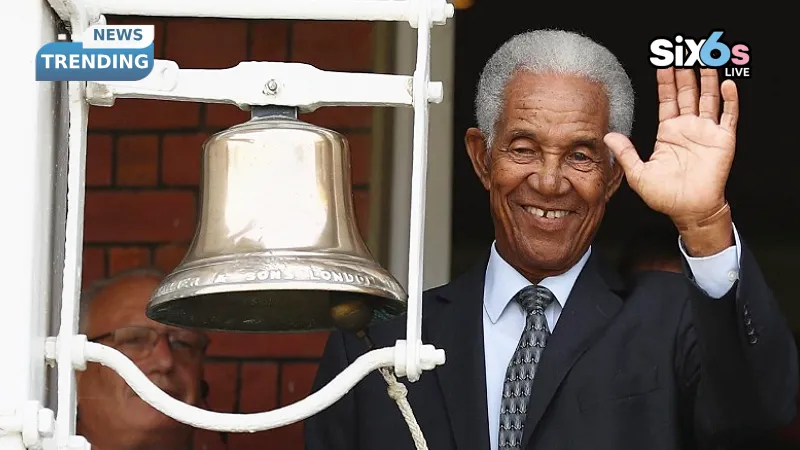
Cricket loses the man most former teammates and rivals still call the finest all-rounder the game has produced. Sir Garfield Sobers died on Friday, July 17, 2026, at his home in Barbados, eleven days short of his 90th birthday. He retired with numbers few players in any era get close to: over 8,000 Test runs, 235 Test wickets, and a 365 not out that stood as the highest individual score in the format for 36 years. Barbados declared a national day of mourning within hours of the news breaking.
A Peaceful Passing at Home
Sobers died at his home in Highgate Gardens, Barbados, on Friday, July 17, 2026. His son Daniel and Cricket West Indies confirmed the news the same day. Daniel described his father’s breathing worsening before he was placed on oxygen and passed peacefully. Barbados Prime Minister Mia Mottley declared a national day of mourning, calling it a solemn hour for the nation, with flags lowered to half-mast and a state funeral announced.
Players in Saturday’s LPL matches wore black armbands in tribute, a small gesture for a career that shaped the sport for two decades. News of his death spread quickly across the cricketing world, with tributes arriving from every corner of the game within hours. Sobers was born in Bridgetown on July 28, 1936, meaning he passed just eleven days before what would have been his 90th birthday.
Garfield Sobers death cricket legacy 2026
Across 93 Tests between 1954 and 1974, Sobers scored 8,032 runs at an average of 57.78, striking 26 centuries and 30 fifties, and took 235 wickets at 34.03 with the ball. His fielding return of 109 catches added to a record built on doing everything a team needed on any given day.
In first-class cricket, he piled up 28,314 runs at 54.87 across 383 matches and claimed 1,043 wickets at 27.74, numbers built over two decades of near-constant cricket across multiple continents. His solitary ODI appearance came in 1973 at Headingley, where he took a wicket in the format’s infancy, and his List A figures read 2,721 runs and 109 wickets across 95 matches.
Records That Defined an Era
His 365 not out against Pakistan at Sabina Park in February 1958, scored at just 21 years old, broke Len Hutton’s mark of 364 and stood as the highest individual score in Test history for 36 years until Brian Lara passed it in 1994. It also remains the only triple century ever scored as a maiden Test hundred.
Ten years later he became the first batter in first-class history to hit six sixes in a single over, taking apart Malcolm Nash at Swansea for Nottinghamshire. He was the first player to reach 8,000 Test runs, in 1974, and captained West Indies in 39 Tests between 1965 and 1972. Don Bradman once called him a five-in-one cricketer, and his batting average of 57.78 still ranks fifth among anyone with 5,000 or more Test runs. His six five-wicket hauls underline that the bowling was never just a side note to the batting.
Knighthood and a Nation’s Tributes
Queen Elizabeth II knighted Sobers in February 1975 at the Barbados Garrison Racecourse, and the island’s Cabinet named him a National Hero in 1998, one of only ten people to receive the honour. Ninety votes from a possible hundred saw him land among Wisden’s Five Cricketers of the Century in 2000, finishing second only to Bradman. The ICC recognised him further with Hall of Fame membership in 2009, and the annual award handed to the game’s best cricketer now bears his name.
Gavaskar saw him as the definitive example of a cricketer at his most complete, someone who could deliver fast-medium, convert to orthodox spin, and then turn to wrist spin across different phases of the same match. ICC chairman Jay Shah described him as the finest all-rounder the game has known, while Brian Lara said cricket had lost its greatest player. Sourav Ganguly and Virender Sehwag both pointed to his six sixes and his 365 as marks nobody in the current game gets near. Every tribute this week has circled back to the same idea: the Garfield Sobers death cricket legacy 2026 leaves behind is one no single word fully covers, because he did more things better than anyone else who ever picked up a bat or a ball.