
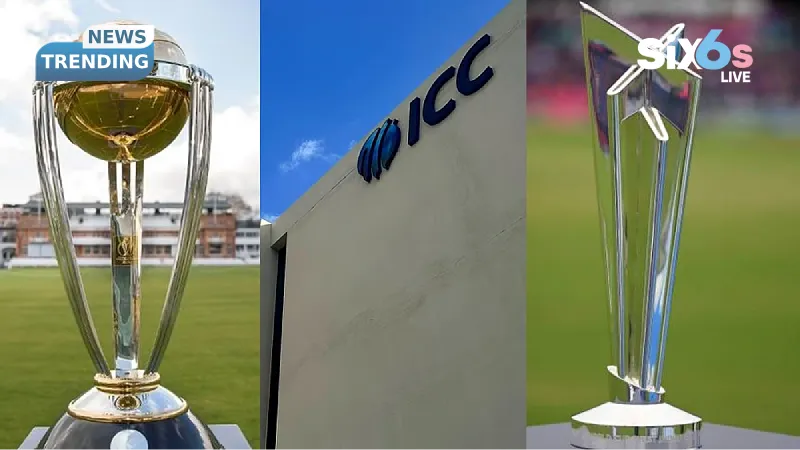
The ICC scrapped both marquee event formats within the same Edinburgh meeting because one tournament exposed a flaw the other hadn’t even faced. February’s T20 World Cup pre-seeding fiasco, where every group winner landed in the same brutal Super 8 pool, forced administrators to rethink how knockout stages get built. The ODI World Cup gets a three-stage gauntlet from 2027, and the T20 World Cup adds a fresh eliminator round from 2028, both aimed at cutting dead rubbers and rewarding group-stage form instead of punishing it.
ICC ODI T20 World Cup Format Overhaul
Both changes were confirmed on July 16, 2026, at the ICC Annual Conference in Edinburgh. The Chief Executives’ Committee recommended the shift, and the Annual General Meeting ratified it the same week, pairing two separate tournament rewrites under one announcement rather than as isolated fixes.
The stated aim was to strengthen the competitive narrative at every stage of both events and to build in more consequence before the knockout rounds begin. Administrators pointed to the volume of foregone conclusions at the recent global T20 event as the trigger for revisiting the 50-over tournament too, even though that event isn’t due for another year. That review weighed qualification pathways and player workload before the board settled on structures it could implement in time for each event.
The New 50-Over Structure Explained
The ODI World Cup 2027 keeps its 14-team field but scraps the two groups of seven that fed into a Super 6 stage. In its place comes a three-tier gauntlet. The three lowest-ranked qualifiers open the event in a round robin, sending only one winner through to a 12-team group stage split into two pools of six.
Three teams from each pool advance automatically, joined by the best-placed fourth side across both groups, producing seven teams for a round-robin Super Seven. The top four then split into semi-finals, first against fourth and second against third. Compare that to 2019 and 2023, when ten teams played one round robin and the top four simply progressed. South Africa, Zimbabwe and Namibia host the tournament from October 4 to November 21, 2027, with ten sides already qualified and four more arriving through a global qualifying event. The extra tier also gives the lowest-ranked qualifiers a genuine route into the group stage rather than an early exit.
Twenty-Over Showpiece Gets an Eliminator Round
The T20 World Cup 2028 stays at 20 teams and 55 matches, but the middle of the tournament looks different. Group play shrinks from four pools of five down to five pools of four, trimming the opening round from 40 matches to 30. The knockout pool grows instead of shrinking.
Ten teams now reach the Super Ten stage, up from eight in the old Super Eight format, split into two groups of five. Group winners go straight through to the semi-finals, while the second and third-placed sides from opposite groups meet in a pair of new eliminator matches to decide who joins them. That shift means finishing third in a five-team pool no longer ends a campaign outright. Twelve nations, including Afghanistan, England, India and Zimbabwe, have already locked in spots for the Australia and New Zealand-hosted event running October 21 to November 19, 2028.
The Seeding Row Behind Both Rewrites
Both rewrites trace back to February’s T20 World Cup, where Super 8 slots were locked in by ranking before a ball was bowled. Every group winner, India, Zimbabwe, West Indies and South Africa, landed in the same pool, while every runner-up drew the easier bracket. South Africa topped its group yet was seeded behind a New Zealand side that had finished second in its own.
Co-host Sri Lanka won every group match but would have needed to fly to India for a semi-final had it advanced, trading home support for a tougher draw. India went on to win a third title in that India and Sri Lanka-hosted tournament. Reporting on the AGM directly linked the criticism of that seeding table to the decision to rebuild both events rather than tweak one in isolation. The backlash over that system is what ultimately pushed the ICC ODI T20 World Cup format overhaul through committee this July, ensuring no side is punished again for finishing on top of its group.
Cricket never stops, and neither do we. Follow Six6slive for the latest news, in-depth features, and exciting updates from the world of cricket. Dive into the action now!