
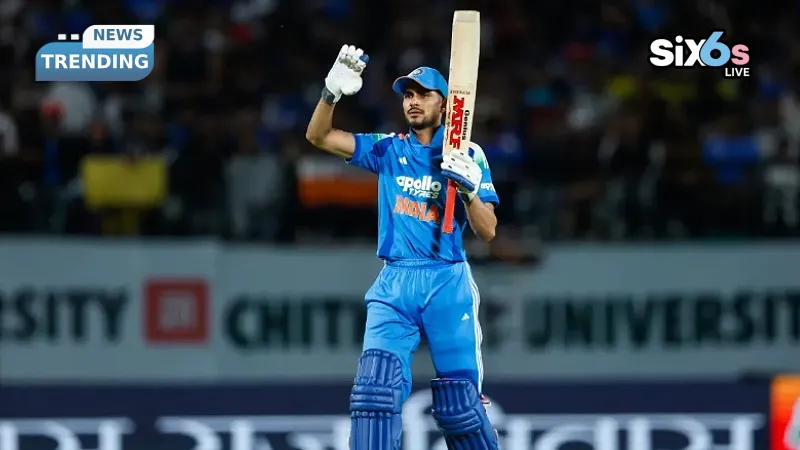
Gill’s jump to No.2 in the ICC ODI batting rankings is the clearest answer yet to a question Indian cricket has been circling for months: is there a genuine successor capable of carrying the top order through a full World Cup cycle without dropping off? Two innings against Afghanistan, 238 runs across two innings at a strike rate of 135.23, three spots gained in the global rankings, and now the No.2 spot sitting 24 points behind the top. The answer, right now, looks convincing.
Shubman Gill ICC ODI Rankings 2026
The ICC issued the rankings update from Dubai on June 24, 2026, following the conclusion of the India-Afghanistan ODI series. Gill moved up three places to No.2, accumulating 791 rating points.
The gap to No.1 Daryl Mitchell of New Zealand is 24 points, with Mitchell sitting at 815. Behind Gill, Virat Kohli holds third at 768 points and Rohit Sharma fourth at 754. Afghanistan’s Ibrahim Zadran rounds out the top five at 712 points.
| Rank | Batter | Country | Rating Points |
| 1 | Daryl Mitchell | New Zealand | 815 |
| 2 | Shubman Gill | India | 791 |
| 3 | Virat Kohli | India | 768 |
| 4 | Rohit Sharma | India | 754 |
| 5 | Ibrahim Zadran | Afghanistan | 712 |
Scores Behind the Series Rise
Gill batted twice across the three-match series. In the first ODI at Dharamsala, he opened and finished unbeaten on 84 off 66 balls. In the second at Lucknow, he dropped to No.3 and made 154 off 110 balls. India won the third ODI by 9 wickets, with Gill not required to bat.
The combined figures across the two innings tell a complete story: 238 runs, one dismissal, an average of 238.00, and a strike rate of 135.23 off 176 balls faced. The unbeaten 84 was controlled aggression at the top; the 154 in the middle order was something else entirely, a century-plus innings that shifted the series before it became a contest.
What stands out isn’t just the volume of runs but the positional flexibility. Gill batted at No.1 in the first match and No.3 in the second, producing match-winning scores from both slots. That adaptability matters enormously heading into a World Cup cycle where India’s batting combination is still taking shape, and no slot has been officially locked in below the top two.
India’s Top Batters by Rating
Three of the top four batters in the current ICC ODI rankings are Indian. KL Rahul sits 11th on 651 points, Shreyas Iyer 14th on 638. Below them, Ishan Kishan is joint 43rd on 516, Yashasvi Jaiswal 71st on 432, and Axar Patel 90th on 389.
The concentration at the top reflects how much ODI cricket India has played in this cycle and the consistency their batters have shown across conditions. But ranking points can mask selection uncertainty. Where Rahul, Iyer, and Jaiswal slot into a 2027 World Cup XI isn’t settled, and Gill’s form resolves one question while several others stay open.
The deeper issue is the gap between the top three and the rest of the Indian contingent in the rankings. Kohli at 768 and Rohit at 754 sit close enough to Gill’s 791 to suggest a tightly contested top order. Below 11th place, the drop-off is steep, and that gap needs addressing before October 2027.
India’s Schedule Before the 2027 World Cup
With Gill named as ODI captain, the fixtures ahead carry real weight. India travels to England for three ODIs: July 14 at Edgbaston in Birmingham, July 16 at Sophia Gardens in Cardiff, and July 19 at Lord’s.
Five ODIs in New Zealand follow from November 4, 2026, spread across Eden Park in Auckland, Wellington, Seddon Park in Hamilton, and Bay Oval in Tauranga across two matches. Three home ODIs against Sri Lanka close out the calendar year on December 13 in Delhi, December 16 in Bengaluru, and December 19 in Ahmedabad.
Eleven matches across three series, in three different conditions, before 2027 arrives. Each one will be read through the lens of captain Gill’s batting, and sustaining his Shubman Gill ICC ODI rankings 2026 form across English swing and New Zealand pace will define whether India arrive at the World Cup as genuine contenders or a side still searching for answers.