
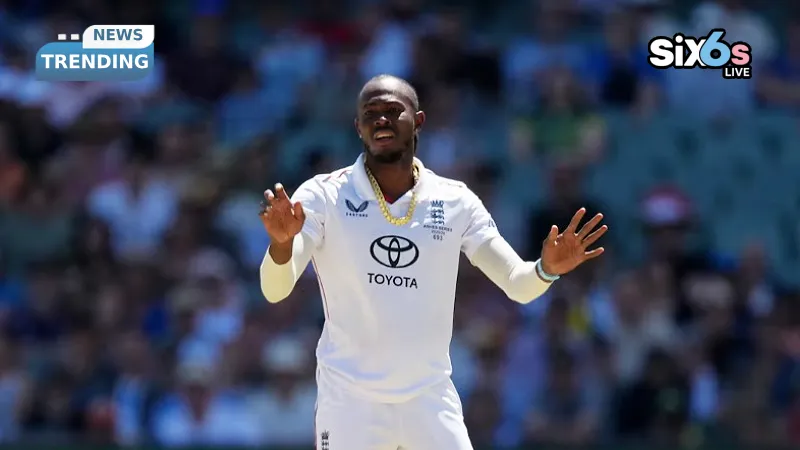
The attack that took 19 wickets at Lord’s won’t be the one England name at The Oval. The pitch won’t allow it, and Archer’s return removes any remaining debate. The pitch won’t allow it, and Archer’s availability removes any remaining debate. What worked at Lord’s was a conditions-specific call built around seam movement and variable bounce, two things The Oval simply doesn’t offer.
Robinson, Atkinson, and Tongue’s Lord’s Numbers in Context
Ollie Robinson took 7 wickets in the match, 5/39 in the first innings, 2/38 in the second, named Player of the Match with a match average of 11.00; his career Test average is now 21.92 across 21 Tests and 83 wickets. Gus Atkinson took 1 wicket in the first innings, then produced a 5/30 in the second; his match average of 7.80 led all bowlers, and his career Lord’s record reads 26 wickets at 9.50. Josh Tongue took 2 wickets in the second innings, including the lbw that removed Tom Blundell on day four.
| Bowler | Lord’s 2026 Wkts | Match Avg | Career Oval Avg | Career Oval Wkts |
| O. Robinson | 7 (5/39 + 2/38) | 11.00 | 12.71 | 7 (1 Test) |
| G. Atkinson | 6 (5/30 + 1) | 7.80 | 15.60 | 5 (1 Test) |
| J. Tongue | 2 | 14.00 | 25.00 | 5 (1 Test) |
| J. Archer | DNP | , | 14.83 | 6 (1 Test) |
Wickets fell every 24.9 balls at Lord’s, the fastest rate in a Test in England since 1907, and 24 of 40 dismissals were bowled or lbw, the most in any men’s Test in England on record. McCullum described the selection as a choice between “air-speed” and “nibble”. The surface told him he got it right.
Why The Oval Pitch Changes Everything
The Kia Oval doesn’t do variable bounce. First innings scores of 400-plus are routine here; par for a Test first innings sits between 380 and 420, with batting sides capable of targeting 500 on a good day. The surface is flat and true, carrying the ball consistently to the keeper rather than producing the unpredictable seam movement that defined Lord’s. Pace bowlers are effective early with the new ball in overcast conditions, but what works here is pace-and-carry rather than line-and-length seam. Spinners don’t factor until days three to five as the surface wears. Devon Malcolm’s 9/57 on this ground remains the benchmark for what pace can do, express carry, not angles.
Jofra Archer, England 2nd Test New Zealand 2026 Oval, Archer’s IPL Form and Fitness Case
Archer finished IPL 2026 third in the Purple Cap standings with 25 wickets from 16 matches for Rajasthan Royals, behind Kagiso Rabada (29) and Bhuvneshwar Kumar (28). He regularly clocked above 150 km/h throughout the tournament and took 3/17 against the Mumbai Indians in the final league fixture, one of the most destructive powerplay spells of IPL 2026. His Test record since returning covers 18 wickets at 27.88 across 5 matches, including a five-wicket haul against Australia at Adelaide in December 2025. He missed Lord’s because of the short post-IPL window, not form or fitness. His career Oval Test average of 14.83 from 6 wickets is the second-best figure in the comparison table, behind only Robinson.
McCullum’s Signal and Who Makes Way
McCullum, speaking after the Lord’s win, didn’t frame Archer’s return as reward or loyalty. His exact words were: “We’re hopeful he will be available for the second Test; then we’ll work out conditions-wise where we’re at.” He added: “You’re not always going to get it right, but you’re trying to pick horses for courses, based on conditions, to give yourself the best chance of winning.” Robinson’s 7-wicket return makes him close to undroppable, whatever the venue. Atkinson, with 76 wickets at 22.50 across 17 Tests and a career-best of 7/45, is England’s most consistent seamer across all conditions and formats.
Tongue’s two wickets at Lord’s came against a batting order already in collapse. Robinson and Atkinson had already broken the match open by then. With nine Tests and 49 wickets at 26.37, and no established record at The Oval at Test level, his case for selection at this specific ground is the weakest of the three. The Jofra Archer England 2nd Test New Zealand 2026 Oval decision follows McCullum’s own logic back to one conclusion: conditions pick the team, and these conditions pick Archer.