
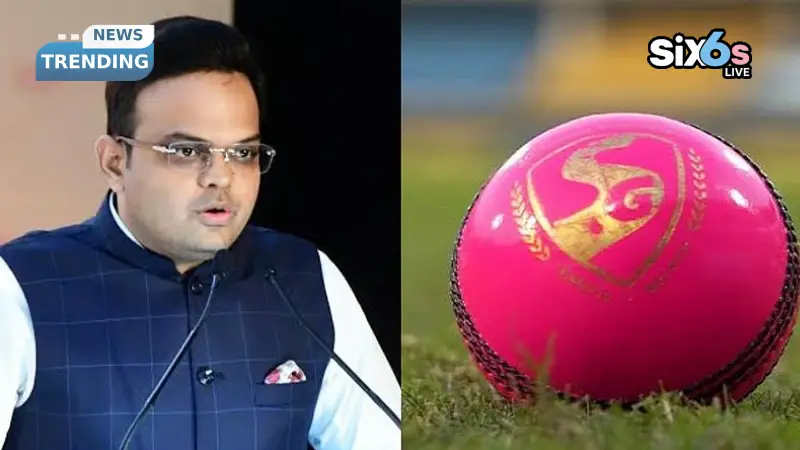
The rule change gives India an option it can still refuse. The ICC Board approved a trial on 1 June 2026, effective 1 October 2026, allowing both teams to agree before a Test begins to use a pink ball if bad light is anticipated. The BCCI hasn’t hosted a day-night Test since March 2022, and Jay Shah’s December 2023 objection, that pink-ball Tests finish in two or three days rather than four or five, has never been withdrawn. The trial doesn’t resolve that tension. It gives the conflict a framework.
The ICC Pink Ball Test cricket Rule Change
The decision came from the Chief Executives Committee and was approved at the Ahmedabad Board meeting on 1 June 2026, chaired by Jay Shah as ICC President. The official ICC Board release confirmed the trial in these words: ‘with prior agreement from both teams, to maximise play in case of anticipated bad light.’ That consent mechanism is the trial’s defining feature. Both sides must agree before the match begins. The red ball remains the default; the pink ball only comes into play if that pre-match agreement is reached.
Pink balls are already standard in day-night Tests; Australia has hosted the majority of the world’s 22-plus such matches, largely at Adelaide Oval. This trial extends the pink ball into conventional daytime Tests without requiring the full day-night format. The new playing conditions take effect on 1 October 2026 and won’t apply to the England–New Zealand series starting 4 June 2026. The ICC Board also approved a separate research programme, co-funded with the MCC, focused on improving lighting technology for venues and match officials.
India’s Pink-Ball Record Since 2019
India has played four pink-ball Tests in total since November 2019. Three were at home. All three home matches finished before the scheduled fifth day; the Bangladesh game at Eden Gardens was done by Day 3, the England game in Ahmedabad was over by Day 2, and the Sri Lanka match in Bengaluru finished on Day 3. The one-away Test, at Adelaide in December 2020, India lost by 8 wickets, a match they had no say in refusing.
| Opponent | Venue | Date | Result | Finished |
| Bangladesh | Eden Gardens, Kolkata | Nov 2019 | Won, innings & 46 runs | Day 3 |
| Australia | Adelaide Oval | Dec 2020 | Lost, 8 wickets | Early |
| England | Narendra Modi Stadium, Ahmedabad | Feb 2021 | Won, 10 wickets | Day 2 |
| Sri Lanka | M Chinnaswamy Stadium, Bengaluru | Mar 2022 | Won | Day 3 |
The Bengaluru Test in March 2022 was the last pink-ball Test India has played anywhere. In the home seasons since 2022–23, 2023–24, and 2024–25, the BCCI has not hosted a single day-night Test despite scheduling multiple home series each winter.
India’s Veto Under the New Rule
The trial’s consent requirement is its most structurally significant feature. Either team can decline before play begins, and the Test proceeds with a red ball under all existing bad-light provisions. There is no penalty for refusal.
India’s objection has never rested on a playing concern alone. Jay Shah made the BCCI’s position explicit in December 2023: matches tend to finish in two or three days rather than the four or five that fans who’ve bought multi-day tickets expect. That’s a commercial objection, not a cricketing one, and it cuts directly into gate revenue and broadcast packages built around a full Test schedule. Commentator Aakash Chopra put the bilateral reality plainly after India agreed to the Adelaide pink-ball Test in December 2024: ‘There is no written rule that you have to play. The consent clause is, in effect, India’s veto preserved in formal ICC language.
India’s Decision Window After October
The October 2026 effective date means the earliest this trial applies to India is its winter home series, likely November or December 2026. That’s when a visiting board would need to agree to the switch before any Test in that series begins. India’s capacity to consent or refuse is unchanged.
Jay Shah approved the rule in Ahmedabad as ICC President, the same position he held at the BCCI when this resistance was taking shape. Whether the BCCI under its current administration agrees to apply it on Indian soil is a question the ICC cannot answer for them.
If improved floodlight standards and better umpire measurement tools can make red-ball cricket viable under fading conditions, the pink ball consent problem becomes less important. Whether the ICC Pink Ball Test cricket Rule Change ends up mattering for India specifically depends on whether the BCCI ever values hosting under floodlights above protecting full five-day crowds.