
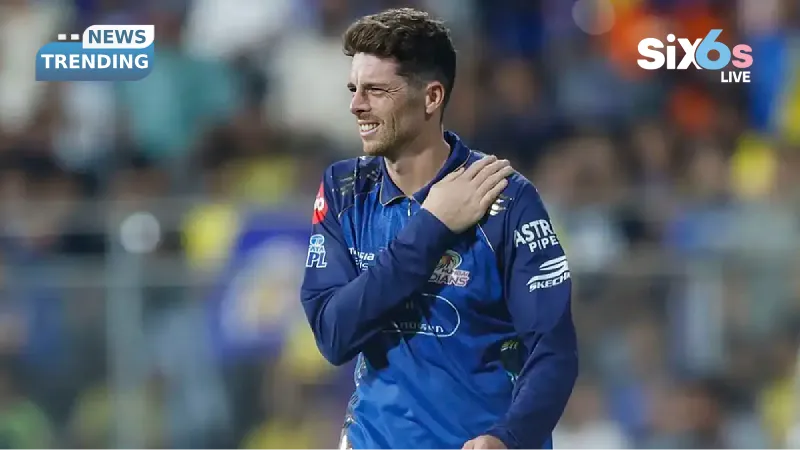
Grade three acromioclavicular ligament injuries don’t always announce themselves at the moment they happen. Santner completed his bowling spell against CSK on April 23 and returned figures of 1 for 44 before the full severity became clear. The minimum one-month recovery window confirmed by medical staff removes him from his Mumbai Indians role, from the Ireland Test, and almost certainly from the opening England Test. Two franchises and one national setup are now managing an absence that arrived without warning and leaves a gap that no single replacement covers completely.
The Injury and Its Real Scale
Grade three AC joint damage is the most severe classification in that injury category. The acromioclavicular joint connects the collarbone to the shoulder blade, and a grade three tear means the ligament has ruptured completely rather than partially stretched. Almost everything in cricket runs through that joint: bowling, throwing, diving in the field, and batting strokes requiring full extension. Santner continued bowling after sustaining the damage, which tells you he’s the kind of competitor who pushes through pain rather than removing himself from the field at the first sign of discomfort.
It also suggests the structural damage accumulated rather than presenting immediately. Once medical staff assessed the injury properly after the match, the picture changed entirely. The one-month minimum window confirmed is the conservative end of what a grade-three tear typically demands, and medical teams choosing rehabilitation over speed is the right call here.
IPL 2026 Costs Mumbai Indians Heavily
Mumbai Indians lost more than a spinner when Santner left the field. They lost a bowling controller, a lower-order contributor, and one of the few players capable of operating effectively across multiple match phases simultaneously. His numbers from last season confirm this directly: 10 wickets across 13 matches at an economy of 7.92, describing a bowler who concedes fewer runs per over than the tournament average while still generating dismissals regularly. That combination is what makes left-arm spinners so difficult to replace in a franchise tournament environment.
The most aggressive batting lineups in the world have been tested against those figures, and an economy of 7.92 across 13 appearances in those conditions tells you Santner was doing something right that no positional swap replicates cleanly. Mumbai’s middle overs now carry a specific vulnerability that wasn’t there when the season began.
New Zealand Loses Spin and Leadership
The tactical problem his absence creates for New Zealand extends well beyond one specialist bowling position. Santner is the left-arm spinner who controls middle overs in English conditions when surfaces flatten, and pace bowlers lose their primary weapons, the white-ball captain whose tactical clarity allows NZ’s quicker bowlers to operate with defined plans rather than adjusting continuously, and the lower-order batter whose T20 World Cup strike rate above 140 confirms he doesn’t merely occupy a position late in the order. He contributes meaningfully to the totals from it.
Without him, New Zealand faces a structural decision: promote a less experienced spinner into a high-pressure Test environment or construct a pace-heavy combination that removes the variety English batters find most difficult when conditions move against them. Neither option replicates what Santner provides across all three dimensions simultaneously.
Return Timeline and the Real Cost
A structured rehabilitation for a grade three AC joint tear moves through three phases: reducing inflammation and restoring mobility first, rebuilding joint strength and stability second, and reintroducing bowling, throwing, and catching loads progressively in the final stage. The one-month minimum window covers the first two. Whether Santner can return to bowling in match conditions within that window depends entirely on how his shoulder responds at each stage without setback.
New Zealand’s medical team will prioritize his white-ball availability over Test readiness, which makes the Ireland Test and opening England Test almost certainly beyond him. His IPL 2026 season is effectively finished from a playing perspective. The focus now shifts entirely to getting him back to full match sharpness before NZ’s white-ball commitments, where his absence creates a different but equally significant structural problem.
Cricket never stops, and neither do we. Follow Six6slive for the latest news, in-depth features, and exciting updates from the world of cricket. Dive into the action now!