
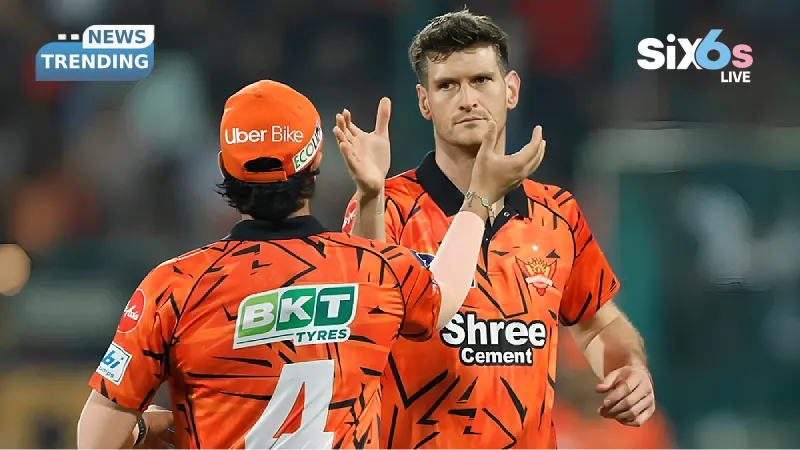
David Payne is out. The ankle injury that ended his season was confirmed this week, and for Sunrisers Hyderabad, it’s another blow they were not equipped to absorb. SRH were already juggling a fragile squad with multiple players unavailable, and losing another overseas seamer complicates an attack that wasn’t functioning at full strength to begin with. Payne wasn’t their headline performer. But the gap he leaves isn’t about wickets or economy. It’s about options, and SRH is running dangerously short on those.
SRH’s Growing Injury Problem
SRH’s squad management has been tested all season. Payne wasn’t an original member brought in at the start. He came as a replacement for someone already unavailable, which is a telling detail. When you’re plugging gaps with replacements, and those replacements get injured too, it stops being bad luck and starts being a structural issue.
Overseas slot constraints make each absence particularly damaging. Foreign players can’t be swapped freely. Every time one is ruled out, the combination shifts, the bowling balance tilts, and the rest of the squad has to overperform to compensate. SRH has needed that kind of compensation too often this season, and it is beginning to wear on the unit.
The IPL 2026 Left Arm Gap
The specific nature of this loss matters beyond just headcount. Left-arm seamers carry a strategic value the scorecard rarely reflects. They shift the line of attack, force adjustments from batters settled against right arm pace, and create angles that keep even well-set players guessing.
Payne was particularly useful across the powerplay and middle overs. Without that option, SRH’s pace attack becomes noticeably predictable. Opposition batting units don’t need much of an invitation to target a one-dimensional pace attack. On flat tracks where variation matters most and there’s nowhere to hide, that predictability turns into a serious liability. It doesn’t show up in one bad over. It quietly drains a bowling unit across all 20.
What the Numbers Miss
Two matches. Figures of 2/35 and 0/35. By those numbers alone, Payne’s IPL 2026 stint looks modest. But evaluating a role player on returns from two appearances misses what he was actually doing in that attack.
Role-specific bowlers in T20 cricket aren’t always there to take wickets. They’re there to create conditions that allow others to. Payne’s presence shaped how the unit was structured, which oversaw how the other seamers were protected from, and how matchup decisions were made at both ends. That invisible contribution disappears entirely when the player isn’t there. SRH won’t feel it in one particular over. They’ll feel it across phases where flexibility was the only workable answer.
Can SRH’s Depth Hold Up?
SRH aren’t out of the race. They’re still in contention on the points table, and in T20 cricket, momentum shifts fast enough that writing off any team before the final few games is premature. The real concern isn’t whether they survive the next match. It’s whether their bowling unit holds together across multiple games without the variation Payne provided.
On pitches with pace and carry, the remaining seamers can manage. On the flat, high-scoring tracks that IPL regularly serves up, things get considerably harder. Finding a genuine like-for-like replacement at this stage is difficult. Asking other bowlers to simply do more isn’t a strategy. It’s wishful thinking. How SRH responds to that reality in the coming weeks will determine whether they’re genuine playoff contenders or a team that ran out of answers at exactly the wrong time.
Cricket never stops, and neither do we. Follow Six6slive for the latest news, in-depth features, and exciting updates from the world of cricket. Dive into the action now!