
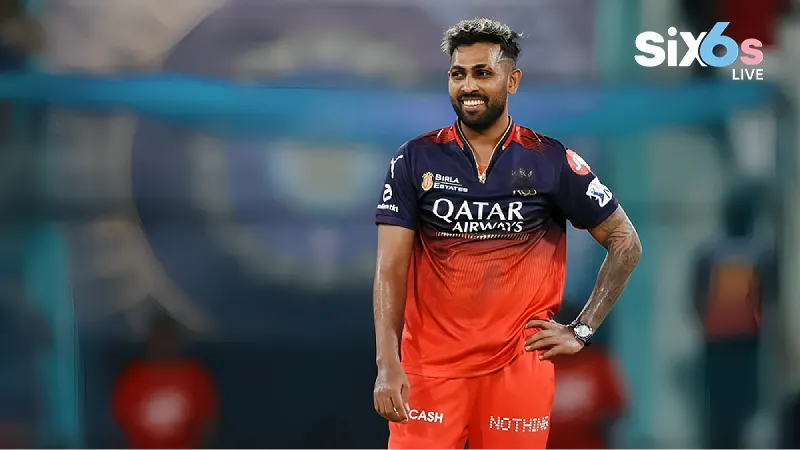
Nuwan Thushara’s central contract with Sri Lanka Cricket expired on March 31. The day after, he was still being told he couldn’t play in the IPL. His argument is simple: no contract means no board control over his professional choices. Sri Lanka Cricket’s argument is that ICC regulations give them authority regardless. Thushara took them to court. The case isn’t just about one bowler missing one tournament. It’s about whether cricket boards can legally control players who aren’t under contract with them, and the answer a court gives will reshape how every board in world cricket handles NOC decisions from this moment forward.
Contract Expired, SLC Still Said No
The legal question at the centre of this case is whether regulatory authority survives the end of a contractual relationship. Thushara’s position is that once the central contract terminated, Sri Lanka Cricket’s power to restrict his professional opportunities terminated with it. The ICC framework gives boards the right to issue or deny NOCs, but that framework assumes a contractual relationship between the board and the player that Thushara argues no longer existed when the refusal was issued. Previous court rulings in similar disputes have sided with players when they were demonstrably no longer under active contracts. Thushara’s case builds on those precedents while introducing the fitness criterion as an additional complicating variable.
Is Fitness Criteria a Deliberate Block
Sri Lanka Cricket’s stated reason for the refusal was fitness, specifically that Thushara failed to meet the minimum threshold in their updated assessment criteria covering endurance, sprint speed, agility, body composition, and explosive power. The problem with using fitness as a reason for denial is the consistency question. Thushara’s camp argues his fitness levels are comparable to previous seasons when NOCs were granted without issue. If the fitness benchmarks were applied differently in this case than in equivalent historical cases, the fitness argument becomes a procedural justification for a decision made on other grounds. The court will examine whether the criteria were applied consistently or selectively.
IPL 2026 Leaves RCB Without Thushara
Royal Challengers Bengaluru signed Thushara for IPL 2026 specifically for his death overs function, the slingy action, the deceptive angles, and the variations that make clean contact difficult on flat surfaces when batters are in full attack mode. His absence creates a specific gap in RCB’s bowling plan that isn’t covered by swapping in a conventional seamer. Death overs bowling is one of the most specialised functions in T20 cricket, and like-for-like replacements don’t exist at short notice. RCB’s bowling combinations across the tournament will reflect the gap, and the results in close matches defended by thin margins will reflect whether that gap proved decisive.
ICC Rules Create a Professional Prison
The ICC’s NOC framework was designed to protect international cricket’s primacy in the global schedule, to ensure that boards could field their best players for bilateral and ICC events without franchise leagues draining the player pool. That intention is legitimate. The problem is that the framework creates a situation where a board can restrict a player’s ability to earn professional income even when the board has no current financial obligation to that player. A non-contracted player whose board refuses an NOC is being told they cannot work in their profession without receiving any compensation from the entity preventing them from doing so. That’s the structural injustice Thushara’s lawsuit is challenging.
If Thushara Wins, Everything Changes Forever
A ruling in Thushara’s favour would establish that boards cannot use ICC NOC authority to restrict non-contracted players from participating in overseas franchise leagues. The immediate consequence is that every player who has deliberately stepped away from central contracts to pursue franchise cricket freedom, a growing cohort across multiple countries, gains a legal precedent supporting their right to do so. The longer-term consequence is that cricket boards must either retain players through competitive contracts that justify the restriction they’re imposing or accept that those players have professional freedom. Both outcomes shift the balance of power between players and boards in a direction that franchise cricket’s growing financial weight has been pushing toward for a decade.
Cricket never stops, and neither do we. Follow Six6slive for the latest news, in-depth features, and exciting updates from the world of cricket. Dive into the action now!