
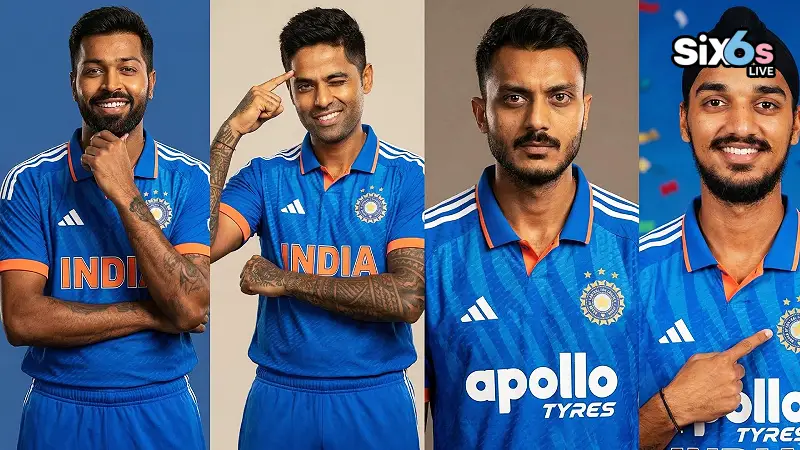
Hardik Pandya: 489 runs at SR 149.54, 28 wickets at economy 8.28, best 3/20 across 23 matches. Suryakumar Yadav: 680 runs at SR 151.11, including 84 not out, 23 matches. Axar Patel: 23 wickets at economy 8.17, best 3/23, 117 runs at SR 130 across 20 matches. Arshdeep Singh: 36 wickets at economy 7.81, best 4/9 across 22 matches. Four players, three tournaments, one consistent truth: India’s T20 core didn’t rotate, experiment, or rebuild between 2022 and 2026. It retained, and it won.
Hardik Pandya: All-Round Power and Finishing Prowess
489 runs at 149.54 and 28 wickets at 8.28 across 23 matches represent the most complete all-round contribution in India’s T20WC history across the three-tournament window. His batting finishes, consistently arriving in situations where India needed 40 from 20 balls and delivering, and his death-overs bowling precision create the specific tactical flexibility that allows India’s captain to manage any match situation without changing the team structure.
His best figures of 3/20 came against South Africa in the 2024 final when India defended 176 by seven runs, the narrowest margin in India’s World Cup final history. That match confirmed Pandya’s value is not just statistical but situational, producing his best performance when the match demanded it most.
Suryakumar Yadav: Middle-Order Aggression and Stability
Suryakumar Yadav’s 680 runs at SR 151.11 across 23 matches represent a sustained middle-order output that no other Indian batter has matched across three consecutive T20 World Cups. His 84 not out in 2026 came in the semifinal against England when India needed acceleration after a powerplay that had produced less than the match situation demanded.
His specific tactical value is the flexibility he gives the captain. SKY can bat at three, four, or five and produce equivalent returns regardless of the situation he arrives in. That positional adaptability means India never needed a plan B for the middle order across three tournaments because SKY functioned as his own plan B simultaneously.
Axar Patel: Spin Control and All-Round Versatility
Axar Patel’s evolution from specialist spinner to genuine all-rounder is confirmed across three tournaments by a specific combination, 23 wickets at economy 8.17 with the ball alongside 117 runs at SR 130 with the bat in 20 matches. His 47 in the 2024 final against South Africa arrived when India needed late acceleration after losing Hardik cheaply in the penultimate over. That innings didn’t just add runs; it changed the match total from competitive to match-winning.
Arshdeep Singh: T20 World Cup Death Bowling and Match Impact
The T20WC 2026 title defence validated the three-tournament retention strategy that India’s selectors had pursued since 2022. Arshdeep’s 36 wickets at an economy of 7.81 across 22 matches represent the best wickets-to-economy combination of any left-arm pacer in history across three consecutive editions. His best figures of 4/9 came in a group match that India won by the largest margin of the tournament, a spell that confirmed his ability to dominate rather than simply contain.
| Player | Matches | Runs | SR | HS | Wickets | Economy | BBI |
|---|---|---|---|---|---|---|---|
| Hardik Pandya | 23 | 489 | 149.54 | 63 | 28 | 8.28 | 3-20 |
| Suryakumar Yadav | 23 | 680 | 151.11 | 84* | – | – | – |
| Axar Patel | 20 | 117 | 130.00 | 47 | 23 | 8.17 | 3-23 |
| Arshdeep Singh | 22 | 21 | 77.77 | 9 | 36 | 7.81 | 4-9 |
- Which of the four do you think contributed most to India’s T20WC success across 2022, 2024, and 2026, Pandya, SKY, Axar, or Arshdeep? Drop your pick in the comments and follow for cricket coverage.
FAQs
Which Indian players played all three recent T20WCs?
Hardik Pandya, Suryakumar Yadav, Axar Patel, and Arshdeep Singh featured in the last three tournaments (2022, 2024, 2026).
Why is Axar Patel considered an all-rounder in T20S?
Axar contributes with left-arm spin, effective mid-overs bowling, tactical batting, and exceptional fielding across varied conditions.
Can Arshdeep Singh’s bowling impact India’s future T20S?
Yes, his death-over precision and wicket-taking ability make him a tactical cornerstone for upcoming tournaments.
What was India’s strategy behind retaining these core players?
The strategy focused on consistency, tactical adaptability, and a balanced mix of all-rounders and specialist bowlers for varied conditions.
Cricket never stops, and neither do we. Follow Six6slive for the latest news, in-depth features, and exciting updates from the world of cricket. Dive into the action now!