
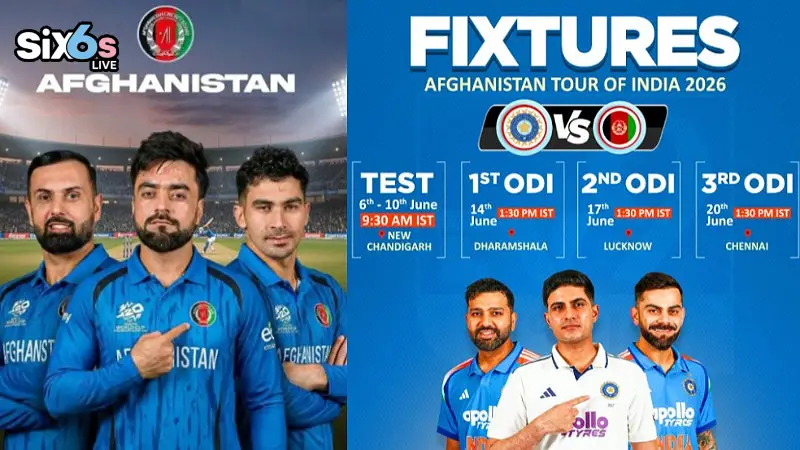
Six days. That is the gap between the IPL final on May 31 and the start of the Test match in New Chandigarh on June 6. India and Afghanistan begin their most significant bilateral series to date with almost no transition window, and that compressed timeline shapes everything about how both teams need to prepare.
The schedule is set. One Test from June 6 to 10 in New Chandigarh. Three ODIs on June 14, 17, and 20 in Dharamsala, Lucknow, and Chennai. For India, this is a bridge between the IPL and a white-ball tour of England in July. For Afghanistan, it is the biggest series they have been offered on Indian soil.
Why the IPL Gap Hurts India
Transition from T20 to Test cricket is difficult in normal circumstances. Doing it in six days after a compressed IPL season is significantly harder. Batters who have spent two months playing 120-ball innings must suddenly rebuild defensive technique for 300-ball sessions. Bowlers who have been restricted to four-over spells in the IPL must find the rhythm of eight-over Test spells under the June heat in northern India.
The Test in New Chandigarh is also outside the World Test Championship cycle, which means India will approach it with squad rotation in mind. Senior players managing workloads across three formats may sit this one out entirely. That is not a criticism of India’s planning. It is a realistic read of a calendar that gives their management almost no space between major competitions.
What the Chandigarh Test Reveals
This is only the second Test between India and Afghanistan. The first was played in 2018 in Bengaluru, where India won in two days. Seven years of red-ball development separate that result from what Afghanistan brings to New Chandigarh in June 2026.
Northern India in June is dry and hot. Surfaces wear through the match, and spin becomes increasingly difficult to play from day three onward. First-innings runs are the priority for both sides. Afghanistan’s spin depth, specifically their ability to exploit surface deterioration in the middle sessions, will be the tactical question that defines whether this match extends into day four or ends inside three days again.
Why IND vs AFG 2026 ODIs Test Real Adaptability
Dharamsala, Lucknow, Chennai. Three venues in six days. Three completely different playing surfaces in the IND vs AFG 2026 series.
Dharamsala’s altitude produces a genuine swing in the first powerplay, favouring seam-heavy attacks and patient top-order batting. Lucknow slows surfaces down, rewarding middle-over spinners and batters who rotate strike efficiently rather than targeting boundaries. Chennai’s humidity amplifies spin from the second innings onward, making powerplay runs more valuable than usual because scoring becomes harder as the match progresses.
For Afghanistan, this variety is the real examination. They have the talent to win on one type of surface. Whether they can adapt their plans across three different conditions within a week is the question that defines how far their white-ball cricket has genuinely developed.
Why Afghanistan Gains the Most
India will rotate. Afghanistan will not. That asymmetry makes this series disproportionately valuable for the visiting side. A full-strength Afghanistan squad facing India’s second and third-choice options in the ODIs gets the closest thing to elite bilateral preparation they have accessed since their ICC ranking climbed. Their openers against the Indian pace in Dharamsala. Their spinners against India’s middle order on a Lucknow turner. Their death bowlers against whoever India fields at Chennai.
Each match is a data point that their coaching staff and selectors will use to build their approach to the next major ICC event. India gets a preparation block. Afghanistan gets a benchmark. Both outcomes matter, but only one of them could prove genuinely transformative.