
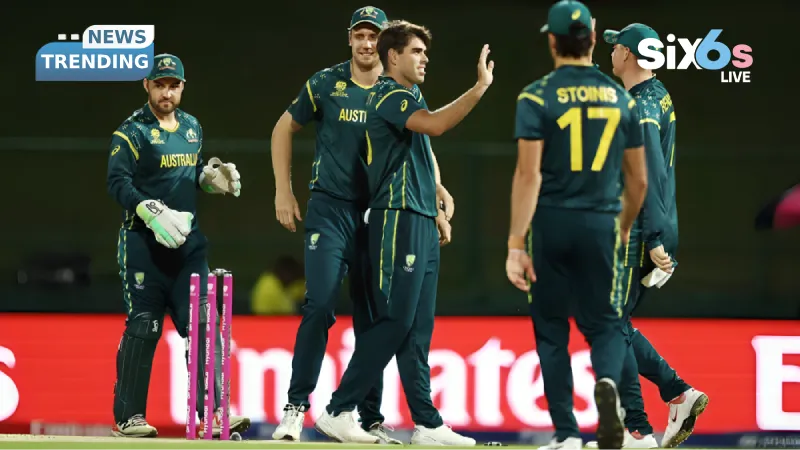
Australia exited the 2026 T20WC because they lacked availability, failed in defining moments, and lost the psychological dominance that once defined their ICC campaigns. Ricky Ponting’s assessment of Australia’s 2026 exit made it clear that this was not simply a bad tournament; it was a campaign in which big players did not win big moments. When analyzing why Australia exited, two results stand out: the shocking Australia vs Zimbabwe T20 World Cup loss and the decisive defeat in Australia vs Sri Lanka. Any credible Australia group stage exit analysis must begin with those pressure failures and Ponting’s criticism of Australia’s campaign execution.
Missing Leaders, Missing Control
Tournament cricket punishes instability. Australia entered the competition without key fast-bowling pillars in Josh Hazlewood and Pat Cummins, while Tim David was unavailable at the outset. In T20 cricket, death overs precision and powerplay discipline define outcomes. Removing experienced enforcers weakens tactical certainty.
Historically, Australia’s ICC success has relied on clarity of roles, new-ball containment, middle-overs squeeze, and calculated acceleration with the bat. In 2026, that rhythm was absent. Senior players did not consistently dictate tempo, and bowling plans appeared reactive rather than assertive. Ponting’s criticism of Australia’s campaign leadership pointed directly at this erosion of control. ICC tournaments reward composure under compression; Australia lacked it.
The Zimbabwe Turning Point in the T20WC 2026
The Australia vs Zimbabwe T20WC 2026 loss was more than an upset; it was mathematically damaging. In short group-stage formats, a single unexpected defeat collapses the margin for error. Australia failed to dominate the early phases, allowing Zimbabwe to believe and scoreboard parity deep into the innings.
Tactically, the warning signs were clear. When favorites do not assert powerplay authority or execute defensively at the death, variance increases. Australia’s inability to close key passages either with the bat or ball suggested structural fragility rather than a one-off lapse. That defeat forced Australia into must-win scenarios immediately, amplifying pressure.
From a tournament architecture perspective, that is how campaigns unravel. Ponting was blunt: the Zimbabwe result likely defined the trajectory of the entire event.
Sri Lanka’s Calculated Chase
If Zimbabwe exposed vulnerability, the Australia vs Sri Lanka run chase analysis confirmed it. Defending competitive totals in subcontinental conditions requires disciplined variation cutters into the pitch, pace changes, and adaptive field placements. Sri Lanka chased with composure, rotating strike effectively and accelerating when required.
Australia’s bowling lacked sustained choke phases. In T20 cricket, even two overs of defensive clarity can flip win probability. Those moments did not materialize. The broader Australia group stage exit analysis shows repeated failure to control transitions between phases, powerplay to middle overs, and middle overs to death.
Ponting’s reference to the missing “aura” is significant. Historically, opponents approached Australia in ICC events with psychological caution. In 2026, that deterrent effect was absent. Sri Lanka and Zimbabwe both played without intimidation.
Transition Pressure and Aging Core
Beyond match specifics lies structural timing. Australia entered the tournament after a physically demanding international schedule. Fatigue and injuries intersected with an aging white-ball core. Players such as Glenn Maxwell may not feature in the next cycle, while Mitchell Marsh and Travis Head are expected to provide continuity.
This is not a talent crisis; it is a transition inflection point. ICC titles demand synchronized form, availability, and tactical sharpness. In 2026, Australia’s alignment was off. When squad evolution coincides with injury disruption, performance volatility increases.
Ponting’s assessment implies that rebuilding the “aura” will require more than personnel replacement. Success will hinge on redefining responsibilities and reinstating composure in crunch moments.
Ricky Ponting on Australia’s T20WC 2026 exit framed the campaign as a failure of execution, leadership availability, and psychological authority. The Zimbabwe defeat removed margin for error; the Sri Lanka loss exposed tactical inefficiencies. Combined with transitional pressures, the result was a rare group-stage exit. Whether 2026 becomes a temporary reset or the start of structural decline depends on how effectively Australia recalibrate their core and reestablish their ICC identity before the next tournament cycle.