
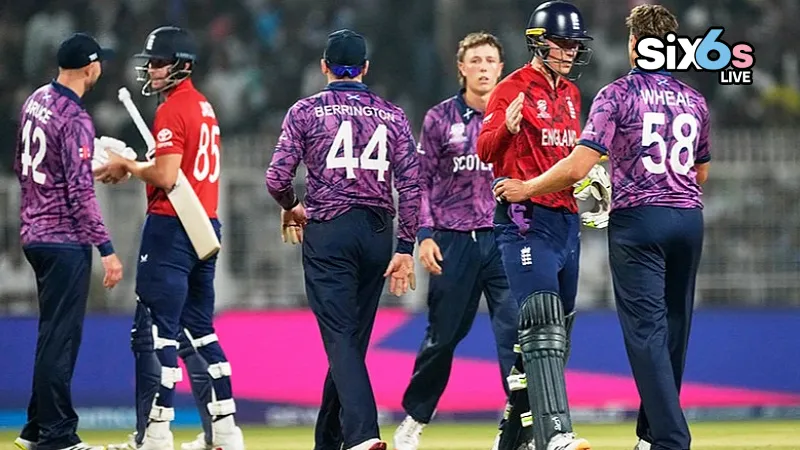
In the England vs Scotland T20WC, England secured a tense five-wicket victory, with Harry Brook’s match leadership and Tom Banton’s Player of the Match heroics steering the team to safety. Key contributions, including Jofra Archer’s bowling performance and smart tactical adjustments, ensured England’s T20 group stage progression remains on track. This analysis examines player form, pivotal stats, and strategic insights behind England’s narrow win over Scotland in Kolkata.
Top-order Performance and Early Momentum
England’s chase began nervously, with openers failing to dominate the powerplay immediately. Brook, as captain, anchored the innings with calculated shot selection, ensuring the team stayed ahead of the required run rate despite early wickets. The top-order partnership provided stability while minimizing risk, and Brook’s experience prevented panic after Scotland’s brief middle-order resurgence.
Scotland’s top order, led by Richie Berrington and Tom Bruce, managed a 71-run fourth-wicket stand, briefly threatening England’s position. However, England’s early breakthroughs with the ball ensured the chase remained manageable, with Brook maintaining a steady strike rotation and building partnerships crucial for the eventual win.
Tom Banton’s Match-Winning Impact
Tom Banton, Player of the Match, showcased why he is a vital cog in England’s lineup. Scoring 63 not out from 41 balls at a strike rate of 153.7, Banton targeted Scotland’s premier spinner, Mark Watt, hitting seven sixes to five compared to Scotland’s tally. His tactical adjustment, opting for straight drives instead of his trademark reverse sweeps, exploited Scotland’s short deliveries and disrupted their bowling plans.
Banton’s performance vindicated his No. 4 position, following two single-figure scores earlier in the tournament, and highlighted England’s adaptability to varying pitch conditions. This innings not only stabilized England’s chase but also demoralized the opposition at a critical stage.
Jofra Archer Bowling Performance and Conditions
Jofra Archer’s bowling performance was instrumental in restricting Scotland’s early momentum. He bowled a disciplined 4-over spell for 2 wickets at 24 runs, maintaining speeds of up to 148 kph while exploiting Kolkata’s favorable bounce. Archer’s hard length and accurate line made scoring difficult for Scotland’s top order, particularly in the powerplay.
The pitch conditions, more suitable than those in Mumbai, allowed Archer to generate movement and challenge batsmen consistently. His performance underscored the importance of pace variation and precision in controlling the match, complementing England’s spin attack led by Adil Rashid.
Middle-Order Collapse and Tactical Lessons
After a promising fourth-wicket partnership, Scotland’s middle order collapsed under pressure, losing five wickets for 39 runs, largely to England’s spin attack. Rashid’s figures of 3 for 36 reflected his continued influence, despite an expensive second over. England’s spinners exploited Scotland’s cross-batted shots, highlighting the tactical value of spin in subcontinental conditions.
This phase reinforced the importance of executing clear plans against spin and maintaining composure under pressure. Tactical clarity, both in bowling and field placement, allowed England to regain control and set a chaseable target of 153.
Implications for England T20 World Cup 2026 Group Stage Progression
With this victory, England remains on course for the Super Eights stage, maintaining momentum after earlier challenges against Nepal and the West Indies. The performance emphasizes Brook’s leadership, Banton’s finishing skills, and Archer’s pace attack as key pillars.
Looking ahead to the match against Italy, England must address minor flaws in top-order acceleration and spin handling. If these tactical adjustments are applied, England is well-positioned to advance confidently and replicate their strong showing on familiar pitches in Sri Lanka during the Super Eights.
The England vs Scotland T20 World Cup 2026 clash highlighted Brook’s leadership, Banton’s decisive impact, and Archer’s precision bowling as central to England’s win. Strategic exploitation of pitch conditions and timely tactical adjustments kept Scotland in check.
If England maintains this form, especially in middle-order partnerships and powerplay execution, they are poised to secure further victories and progress smoothly through the group stage. Tactical refinement against Italy will be critical, but the team’s current momentum suggests a confident start to the Super Eights campaign.