
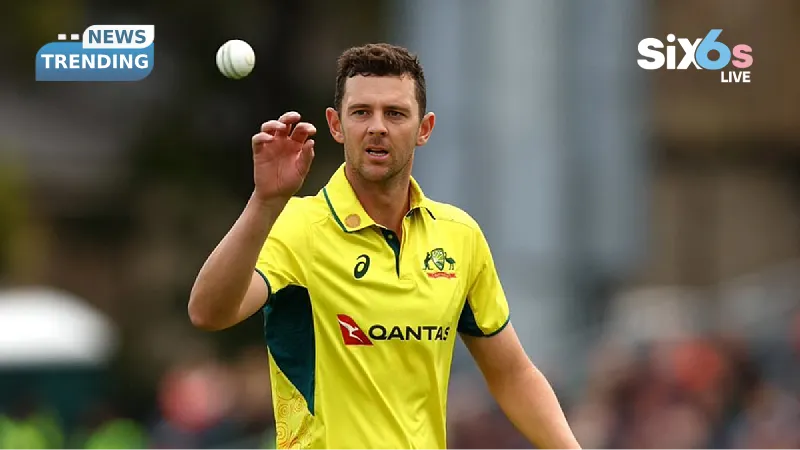
Josh Hazlewood’s ruling out of the tournament is a major setback for Australia. days before the WC begins, forcing a reshuffle in their pace strategy and raising fresh questions about depth. The latest Hazlewood injury update confirms he hasn’t regained full fitness in time, adding to broader Australia squad news that already includes concerns around Pat Cummins’ injury status. With two senior quicks unavailable, Australia now faces significant fast bowling attack changes, especially in spin-friendly Sri Lanka and India conditions.
Hazlewood’s Absence Explained Clearly
The decision to withdraw from the T20 World Cup is based on caution, rather than haste. While selectors felt that Hazlewood was still short of match fitness, they also felt that speeding up his recovery would expose him to increased risks, particularly given that he has been out for several months because of a recurring problem with his Achilles tendon. From a management viewpoint, it would be far more detrimental to lose another player to injury in the middle of the tournament than to withdraw now.
Therefore, the decision made by selectors can be considered to be prudent (as opposed to impulsive). Australia’s preference is to enter the competition with all bowlers fit and healthy, as opposed to being forced to select players who are injured or unable to play during the “Super 8” stage of the competition. The loss of one of Australia’s leading new-ball operators will severely disrupt the bowling line-up that has been carefully planned and developed.
T20 World Cup Powerplay Control Takes a Hit
Tactically, Hazlewood’s biggest value lies in control with the new ball. He typically bowls hard lengths, hits the seam, and keeps scoring rates down in the powerplay. In Asian conditions where early wickets are critical before spin dominates, that role becomes even more important.
Without his presence, Australia may rely heavily on Nathan Ellis and/or other options that can provide some variety of pace; however, they will likely lack the consistency that Hazlewood brings in terms of a steady run rate in the early stages of an innings. As such, the nature of their bowling mix would likely change, from “contain and choke” to “variety and gamble,” which would increase volatility in the opening six overs of an innings.
Squad Depth and Replacement Options
Selectors have delayed naming a replacement, suggesting confidence in bench depth. That hints at flexibility rather than a like-for-like swap. Australia could:
- Add another seamer for bounce-friendly venues, or
- strengthen spin resources for Sri Lanka and India surfaces.
Recent news shows Nathan Ellis and Tim David are fit, while Adam Zampa is expected to start. That combination signals a spin-heavy middle-overs strategy backed by all-round options. In effect, Australia may adapt line-ups based on venue rather than forcing a single bowling template.
Cummins Situation Adds Pressure
The main worry is an accumulation of that type. The Pat Cummins injury status has already limited leadership and bowling experience among the fast-bowling group. Therefore, with both Cummins and Hazlewood absent from the bowling line-up for the start of the tournament, Australia is losing its most experienced enforcers, who usually provide pressure relief by bowling through difficult periods at the beginning of matches and during the death overs. This will push the responsibility for these types of situations to the younger players in the Australian squad. While there is certainly a lot of bowling talent in the Australian side, tournament knockout phases very frequently rely on the composure and ability to repeat performances under pressure, abilities normally provided by veteran players.
With ongoing injury concerns for other bowlers as well, they will have to rely on depth, versatility, and spin-heavy tactics to remain competitive. If the replacement bowlers perform well, then the loss should be able to be compensated for. If not, they could be exposed in the first 6 overs. Australia will likely switch attacking options based on venues, which may ultimately determine the direction of the Australian teams’ tournament.
Stay updated on the latest cricket news and exciting updates at Six6slive. Dive into our in-depth articles and analyses to connect with the action today!