
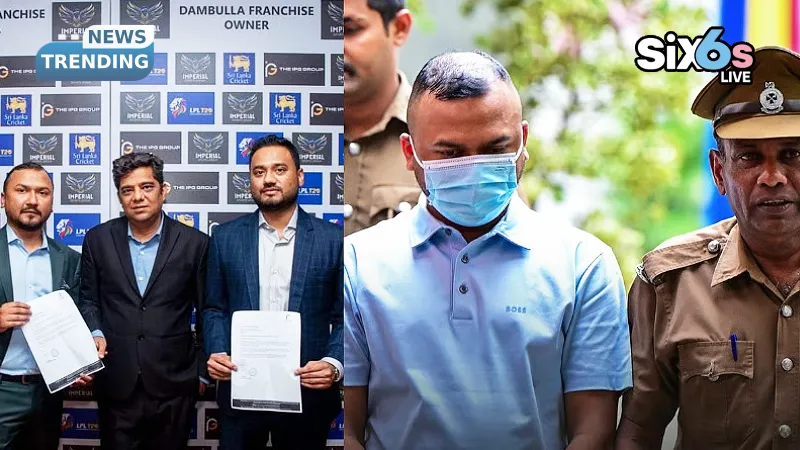
Private money chasing public trust in a peaceful partnership – that’s the hidden and delicate base of all the firework displays and brand franchises of today’s international cricket. When the owners behind Sri Lanka’s Lanka Premier League were looking for a way back into the world of commercial cricket, they thought they had found it with the Lanka Premier League. But the LPL’s first major case of corruption did not come from one of their players delivering a no-ball or being involved in a suspicious run-out; it came from an owner’s box.
When Ownership Becomes the Weakest Link
Cricket’s anti-corruption discourse has focused on players underpaid, exposed, and vulnerable. The LPL case is an exception. Rahman was not a fringe cricketer barely making ends meet; he was a franchise owner with access to players and structural power.
The Sri Lanka Prevention of Offences Relating to Sports Act (2019) was passed to punish those who use their influence to impact players’ behavior, and Rahman’s guilty plea proves it works as intended. The act of allegedly pressuring a player in the middle of the 2024 LPL is at the center of current risks associated with franchises. Ownership does not require finesse or subterfuge. Owners have control of the contracts, the environment, and the future of the players they own. Therefore, when ownership is compromised by corruption, no amount of seminars will provide adequate protection against corruption.
A League Built on Constant Reset
The Dambulla franchise’s path to success is as much about business as it is sports. As the franchise’s name has gone from the Dambulla Thunders to the Dambulla Sixers during the time of Sequoia Consultants, the Dambulla franchise has had its ownership change for a fourth time since 2020. This isn’t an example of growing pains or evolutionary growth as it is a lack of stability.
None of the teams participating in the LPL 2026 season have their original ownership group, as all teams will be undergoing their third change of ownership as of the start of the new season. In comparison, while the IPL has experienced controversy, one of the key elements of the IPL that has created stability was the continuity of ownership among the various franchises. Frequent changes in ownership create confusion within the league, hinder governance, blur accountability, and ultimately provide ample opportunities for corruption to occur.
Law Enforcement Finally Enters the Game
One quiet yet important aspect of this case is who brought the matter to light. It was the ICC’s Anti-Corruption Unit that alerted to this matter, and it was this notification that led to coordinated action from Sri Lanka Law Enforcement agencies. This is an important factor.
In the past, Cricket Boards have generally been hesitant, preferring internal sanctions to formal court proceedings. Sri Lanka’s decision to prosecute as a criminal proceeding (as opposed to using an internal sanction) for wealthy foreign players represents a break from the past and may be seen as a new trend. The recent prosecution of Anurag Thakkar in relation to corruption charges in the Lanka T10 League and the current case against Sachithra Senanayake demonstrate that Sri Lanka will no longer settle for symbolic justice.
Money, Speed, and the Franchise Temptation
The LPL’s battle is by no means isolated. All of the younger professional leagues have the same contradiction: while an increase in size requires money, a quick and accurate review process leads to increased risk. When leagues put financial statements before background checks, fraud does not creep into the system; it is welcomed.
The arrest of Rahman in May 2024, while attempting to exit the United States, exemplifies how globalized and temporary the ownership of franchises has become. Cricket boards are competing for not only sponsorship dollars but also for credible ownership. Credibility, such as with cash, is something that cannot be verified quickly.
Tamim Rahman’s conviction, while being a rare win in anti-corruption enforcement, is also a sign to the owners that they can no longer hide behind glass walls. The conviction of Tamim Rahman shows that the owners will be held accountable under the law.
Stay updated on the latest cricket news and exciting updates at Six6slive. Dive into our in-depth articles and analyses to connect with the action today!