
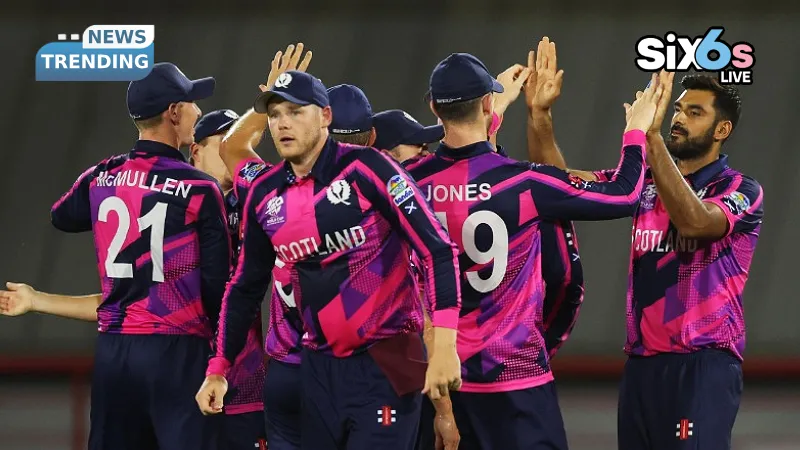
Scotland’s journey to the 2026 T20 World Cup has a subtle irony. Almost 19 years ago, Scotland arrived in the first T20 World Cup in 2007 as an underdog. Scotland will now arrive in 2026 as not just a team looking for their seventh trip to the World Cup, but as a team with an intention.
Leadership Built on Scar Tissue
Richie Berrington may captain more than one Scottish team; he can captain an accumulation of years of international cricket experience. His worth is not in how many runs he can score, but in his experience in reading a game and managing the timing of the game. In past World Cups for Scotland, it was the mid-overs where their tournament would begin to unravel. Berrington’s measured approach to tempo management is a method to halt this trend.
Berrington’s partnership with Dawkins will also be crucial to Scotland, as well as the type of leadership that they will have. The partnership of Berrington and Dawkins is based on a pragmatic approach to leading a team, not by using empty slogans. Expect Scotland to focus on specific match-ups, flexible lineups, and conservative approaches to bowling during the power play instead of looking for a way to create a perceived sense of excitement or bravado.
Tom Bruce and the Art of Borrowed Experience
At thirty-four years of age, Tom Bruce is an existing solution as opposed to a potential future investment. With seventeen T20I appearances for New Zealand, Bruce has already experienced high-quality fast bowling and hostile spin in high-pressure environments. Scotland typically doesn’t experience these types of pressures.
Therefore, Bruce’s inclusion in the side is purely for his tactical value. Historically, Scotland has struggled with the issue of depth when it comes to their batting under pressure. However, Bruce can provide that one thing which is invaluable to Scottish cricket – he is capable of absorbing extreme pressure and therefore does not lose his wicket to dot balls. Therefore, at times like this, this type of skill will be more valuable in India than a raw strike rate.
Spin as Strategy, Not Insurance
The core of Scotland’s subcontinental thinking is Mark Watt, Chris Greaves, and Michael Leask. It’s a deliberate attempt at control, rather than an effort at balance. The slow bowling from Watt has already posed problems for the better-ranked teams, especially in conditions where the ball slows down and the batsman reaches too far ahead.
Scotland’s bowlers will be expected to contain, mislead, and manipulate the rate of play. Control is king in T20 cricket, and Scotland has made the right investment.
Zainullah Ihsan and the Calculated Risk
Everyone’s got to have some kind of Wild Card in every World Cup Squad. For Scotland, it is probably Zainullah Ihsan. He was born in Afghanistan, and there are genuine concerns about his speed, but like many of Scotland’s players, he has no experience of playing for Scotland at the senior international level.
The conditions in India will be very conducive to fast bowling, particularly in the early stages of the match. So, it is clearly defined what Zainullah Ihsan will do. Hit the pitch as fast as possible, get batsmen into trouble with poorly timed shots, and cause general mayhem before the spinners can take control. It’s a risk, and it is a risk taken based on logic, not desperation.
Scotland is not going to get a soft start in Group C. England will be full of firepower, West Indies will be volatile, Nepal will have a disciplined approach to tactics, and Italy will be unpredictable. Scotland’s first match for the West Indies at Eden Gardens on 7th Feb. Is more than symbolic; it is diagnostic.
Stay updated on the latest cricket news and exciting updates at Six6slive. Dive into our in-depth articles and analyses to connect with the action today!