
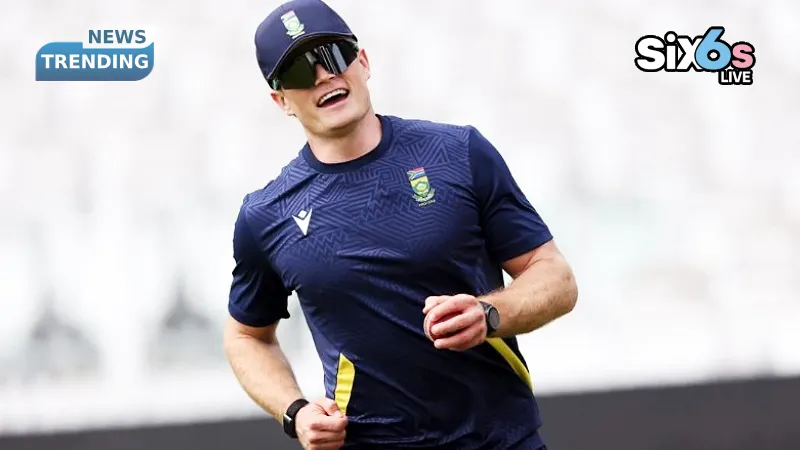
There’s an interesting paradox about modern-day cricket: the players are being told to reach their peak form at the right moment, but the selection of teams is typically done prior to them reaching this peak form. Ryan Rickelton’s return to South Africa’s T20 World Cup team is not simply a heartwarming comeback story; rather, his return is a case study on how poorly announcing your squads too early can come back to haunt you.
Eight days prior to CSA announcing its World Cup Squad, on January 2nd, Rickelton scored a 63-ball century of 113 for the SA20. Eight days later, he was again hitting a loud ton, this time 113* off just 60 balls at the Wanderers. Yet still, his name did not appear on that World Cup Squad List. Injury to another player (Tony DeZorzi’s hamstring) eventually opened that door back up for him.
Premature Selection, Predictable Fallout
CSA’s deadline for announcing their 23-man squad was Jan 31. CSA announced it on Jan 2. The price paid by CSA for that decision quickly followed. CSA’s decision to overlook Rickelton after his back-to-back SA20 hundreds made the omission seem more about administrative convenience than strategic thinking. History has demonstrated, as seen with England’s hurried selection in 2019 and Pakistan’s long-standing practice of making last-minute changes, that form windows in T20 cricket have a short shelf life. By locking a 23-man squad early in this format, you reduce your ability to adapt to the many variables involved in the rhythm-based nature of the format vs the reputation-based nature of Test Cricket.
Form Isn’t Loud, Until It Is
Rickelton claims “he wasn’t trying to make a statement”. The same is said by players all of the time, but most of the time their scoreboard tells a different story. What Rickleton did in SA20 wasn’t wild or out of control (reckless) hitting, his was controlled tempo batting which absorbed the pressure and then started to accelerate with it. That is an important piece of information to know when considering a South African team, which has historically been guilty of collapses from over 7 to 14 in the match. As a no.3 batter, Rickelton provides a link/bridge, not a risk taker.
Opportunity Created, Not Claimed
Rickelton was given an opportunity by way of injury rather than forceful knocking on the selectors’ door. De Zorzi’s hamstring pull and Donovan Ferreira’s broken shoulder provided the opportunity for Tristan Stubbs to be called up. The commonality in all three selections is that they were depth players who have been required to take a major role due to circumstance. Contingency planning will always be as important or even possibly more important than the selection of your “A” team.
Asia: Numbers That Demand Correction
India has not been good to Rickelton. He averages 17.33 across all formats in India and Pakistan. He’s had 7 innings where he didn’t pass 45. His last memory of Asia was two ODI ducks in Ranchi and Visakhapatnam. However, to dismiss him based solely on those facts doesn’t account for his adaptation to the IPL’s slower pitches, the middle overs with an abundance of spin, and his ability to rotate the strike at a rate of 150+. The version of Rickelton suited to India would be the one he developed through playing in the IPL.
Ryan Rickelton’s return is emotionally compelling rather than cinematic because it is corrective. South Africa did not find Rickelton overnight; they remembered him as circumstances allowed. In doing so, the return of Ryan Rickelton reveals an even larger truth that in T20 cricket, players’ forms are moving much faster than the administrative timeframes that govern them.
Stay updated on the latest cricket news and exciting updates at Six6slive. Dive into our in-depth articles and analyses to connect with the action today!