
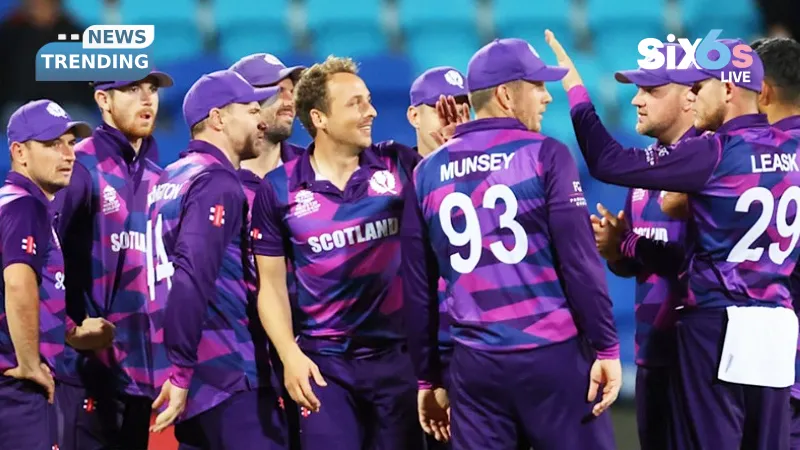
In addition to being steeped in romance, cricket is also known for its harsher administrative side. In this vein, the abruptness of the decision by the International Cricket Council (ICC) to replace Bangladesh with Scotland in the men’s Twenty-20 World Cup in 2026 was indicative of both sides of that duality. At first glance, replacing a full-member country with an associate member of the ICC would appear to be shocking; Bangladesh is a full-member of the ICC and has experienced nearly two decades of participation in World Cups. However, in actuality, the shock was more akin to feeling the effects of gravity than feeling a bolt of lightning.
Deadlines Are the ICC’s Sharpest Weapon
The real story here isn’t about Scotland inviting them, or Bangladesh accepting; it’s about Bangladesh defying the ICC. What the BCCI wrote to the ICC Board in their letter clearly stated that they were not going to comply with a board decision. The BCCI stated that “the ICC had no other options.” What the BCCI said was important, as it shows how rare it is for the ICC to take such action against a full member (and what happens historically when they do). The fact that governance failure was the cause of this expulsion is more important than the result of the team on the field. In today’s world, hosting rights, windows for scheduling, and commercial viability are what drive the decisions of the ICC, so inaction/non-compliance will get you expelled immediately.
Scotland’s Ranking Was the Cleanest Justification
Scotland was selected based on procedure rather than emotion. They were ranked 14th and therefore were the highest-ranked team not to have already been qualified to participate in the tournament. The ICC could then apply a “defensible and regulation-compliant” criterion for their selection of Scotland as the best option for them administratively, politically, and legally (avoiding potential “noise” from legal or political issues). The selection of Scotland also provided an opportunity for the ICC to select a wildcard without having to use a subjective panel, and therefore avoiding the controversy of selecting a wildcard. Therefore, from the perspective of the ICC, the selection of Scotland was the “path of least resistance.”
A Familiar Underdog With Proven Disruption
Scotland have been here before; if it seems like a fairytale, that’s because they’ve played Bangladesh in the group stages of the 2021 T20 World Cup (an irony too sharp to ignore). In 2022, they took down West Indies; by 2024, Scotland were tied for points with England but lost out due to net run rate. Scotland is no neophyte. Scotland has gained a reputation as an “inconvenient” team in tournaments: rarely dominant, frequently the underdog, yet capable of putting a big-name player off their game.
Qualification Failure, Then Administrative Resurrection
Scotland was denied a spot in the tournament on their own merits. In fact, they finished fourth in the European qualifiers, behind both the Netherlands and Italy. However, this is not an isolated incident. History has shown that the same scenario was true for Scotland when they played at the 2009 T20 World Cup, after Zimbabwe withdrew from the tournament. In essence, while it may seem logical to assume that the “ICC” would provide a fair and equitable opportunity for all teams to compete, it is clear, based upon experience, that sometimes, due to administrative issues within other countries, opportunities arise for teams that would otherwise be unable to participate based solely upon performance.
Group C Suddenly Looks More Volatile
Scotland will be in Group C, competing against the West Indies, Italy, England, and Nepal. On paper, it is likely that England and the West Indies are going to have to compete for first place. In reality, however, Scotland’s inclusion in the competition has altered the psychological dynamic of the competition. Both England and the West Indies are very much aware of what happened in 2024 and 2022, respectively. While Scotland does not frequently win their pools in World Cup competition, they do an excellent job of creating uncertainty and complications in pools where others may believe they can easily advance. As such, for fans who watch without allegiance to one team or country, this pool has become less predictable, which makes it more exciting and thus more desirable as a spectator experience.
Bangladesh’s withdrawal from the T20 Cricket World Cup in 2026 is neither a cricket decision nor a judicial one; it is an administrative one. In its judgment, the International Cricket Council (ICC) clearly stated that membership of the full member status does not guarantee protection; it will be based on compliance rather than legacy. Meanwhile, Scotland, having narrowly missed entering this tournament last time, has gained valuable experience and a prior history, as well as a lot to lose.
Stay updated on the latest cricket news and exciting updates at Six6slive. Dive into our in-depth articles and analyses to connect with the action today!