
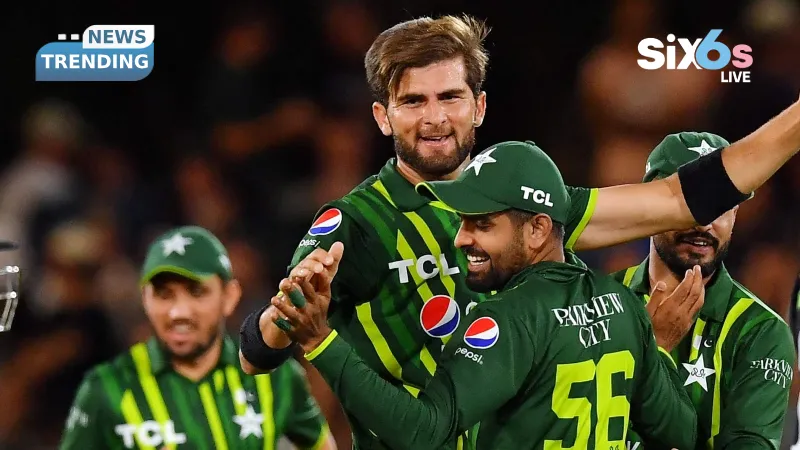
Pakistan’s T20 planning has taken a rather… odd turn for a side that views chaos as an asset. The return to action for Babar Azam and Shaheen Shah Afridi ahead of the Australian T20Is in Lahore will be more than just an opportunity to select their best XI again; it’ll also represent a very quiet acknowledgment from the Pakistan Cricket Board (PCB) that the time for experimentation is well and truly over. At least one of the major probable core teams for the upcoming T20 World Cup in India and Sri Lanka is now out there early, while other teams still try to find a combination that works.
Experience Reasserts Itself
Pakistan’s selectors are essentially stating they are moving forward after the Sri Lanka series with the return of both Babar and Shaheen. The inclusion of these two players signals an emphasis on using experience at the top of their selection pool. As you can see in T20 cricket, leaders need to be clear in their decision-making as well as having the ability to hit big shots, and Babar is still the central figure around whom the rest of Pakistan’s batting tempo revolves. Babar’s struggles in the Big Bash (similarly to how Virat Kohli struggled in his first few seasons of IPL) do not take away from a decade of high-level performance in all white-ball formats.
Similarly, the inclusion of Shaheen is a bigger message. Historically, Pakistan’s identity in the T20 format has always revolved around being pace-first, from Wasim Akram’s blueprint in ODIs to the new ball destruction of Shaheen. Now, a fully fit Shaheen, even if he was only 90%, provides the Pakistan team with tactical balance to an otherwise very heavy reliance on spin bowling.
Big Bash Lessons, Not Big Bash Numbers
Haris Rauf was a success in his stint with the Big Bash League because he was able to perform at his best under pressure. He was able to utilize his speed and length to find consistent results. On the other hand, Babar, Rizwan, and Shaheen were unable to produce similar results for the same reason that they had been successful in their respective countries. They faced unfamiliar pitches, longer boundaries, and an unrelenting amount of different matchups, which pushed them outside of their comfort zones.
In Pakistan’s case, it was never a failure of cricket – it was just data. There are many examples in Pakistan’s history of batsmen who have been very poor at the international level before major tournaments (e.g., Misbah-ul-Haq before 2009) that were then very good. The key is how you interpret their performance. Now, Babar will need to shift his focus away from his strike rate and consider how he can create tempo while playing to the requirements of his powerplay match-ups, both with the bat and ball. Similarly, Shaheen’s biggest takeaway from his time on tour was learning how to manage his durability, not how many wickets he could take.
Home Conditions, Global Implications
The games played at Gaddafi Stadium are all more important than they appear to be in terms of score. The pitches in Lahore tend to be flat when new but will get very gripping as they get older, and the same can be said for most pitches that Pakistan will play on in India and Sri Lanka. Shaheen is working on getting into a better rhythm with his powerplays and for Babar, he needs to redefine how he goes about scoring while keeping a check on his control over the game.
Pakistan’s call back to Babar Azam and Shaheen Afridi is not a nostalgic exercise – it is an exercise in risk management. At the point that the T20 World Cup is looming large, Pakistan has opted for certainty as opposed to curiosity, hierarchy as opposed to chaos. The omissions of Rizwan and Rauf suggest a more defined selection philosophy, while Salman Agha’s opportunity to lead may indicate a longer-term restructuring of how Pakistan wants to play T20 cricket.
Stay updated on the latest cricket news and exciting updates at Six6slive. Dive into our in-depth articles and analyses to connect with the action today!