
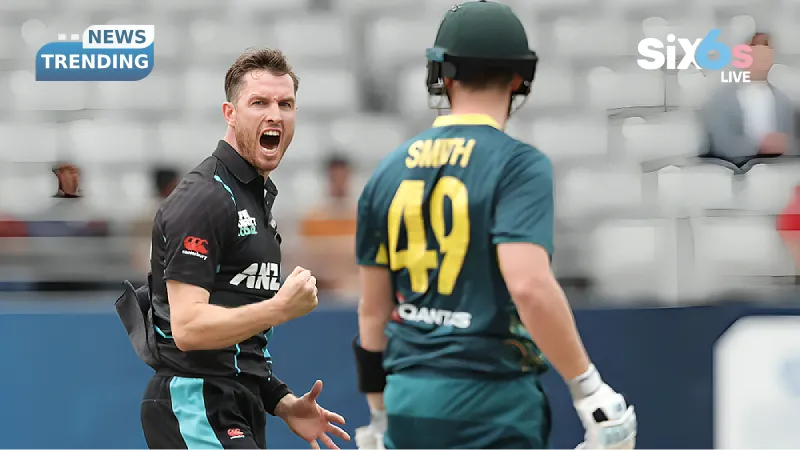
New Zealand has been a source of excitement for fans around the world in the form of its fast bowling talent; however, these same players are typically as unstable as they are explosive at international competitions. The loss of Adam Milne to injury in the T20 World Cup via a left hamstring tear will be seen as more than just an unfortunate loss for the player; it could also be viewed as yet another episode in the ongoing story of how difficult it has been for the Black Caps to maintain a consistent fast bowling unit in major tournaments. Before his injury, Milne had found his groove again by playing in the SA20 for Sunrisers Eastern Cape. He had played in eight very competitive games, and now all of that momentum has come to an end.
When Depth Becomes a Mirage
The Paper Depth of New Zealand’s Fast Bowlers Looks Promising, But in Reality It Is Extremely Fragile. If Milne Is Out Due to Injury, and Ferguson Has Only Just Returned to Cricket with a Calf Injury, and Henry Recently Returned from an Injury Layoff, There is Very Little Room For Error. With the expected paternity leave absence of both Ferguson and Henry during the Tournament, “Depth” Does Not Feel Like Something That New Zealand Will Be Able To Count on, but More Like An Idea Rather Than A Reality. T20 Tournaments Reward Teams with Players Who Are Available as Much As Those Who Have Ability—An Area Where New Zealand Is Quietly Being Overtaken.
Why Jamieson Is More Than a Replacement
Kyle Jamieson’s inclusion is not a like-for-like replacement for Milne, and that makes a difference. The two men bring different types of pace to their bowling. Milne has raw speed and can be hostile and hit the deck. Jamieson, on the other hand, provides bounce, control, and more importantly, tactical options. He also provides height (6’8”), which gives him the ability to change his angle of attack, rather than relying on clocking up high speeds with his bowling action. In terms of value, he is a player who will provide a level of discipline at the top of the order and will help contain opposition middle-order batsmen’s skills that have generally stood the test of time in all forms of global Twenty20 cricket. New Zealand is not simply replacing an injured fast bowler; they are gradually adjusting their overall bowling style.
Injury Cycles and the SA20 Question
Milne’s injury happened while playing in the SA20, a league that many Kiwi cricketers are using as their go-to competition to get the quality T20 match practice they need. That leads to a very uncomfortable question: are the large amounts of bowling needed in franchise cricket undermining the ability of our top players to prepare properly for internationals? Milne had bowled at full throttle across several spells in South Africa, only about three weeks before the World Cup. History has shown us that similar injuries have forced some of New Zealand’s most important fast bowlers off the park ahead of the 2019 and 2022 ICC tournaments. We can no longer ignore this trend.
Adam Milne’s injury isn’t just a personal tragedy; it’s a strategic red flag that New Zealand Cricket can’t ignore. Kyle Jamieson will do a great job of filling in for him, but when you replace one high-quality bowler with another, that shows an adjustment rather than an abundance of depth to the team. The Black Caps are heading into the T20 World Cup with all the skills, experience, and tactical smarts you could want from a team. Their fast bowling unit is being maintained on a tightrope with very little room for error in terms of both planning and luck.
Stay updated on the latest cricket news and exciting updates at Six6slive. Dive into our in-depth articles and analyses to connect with the action today!