
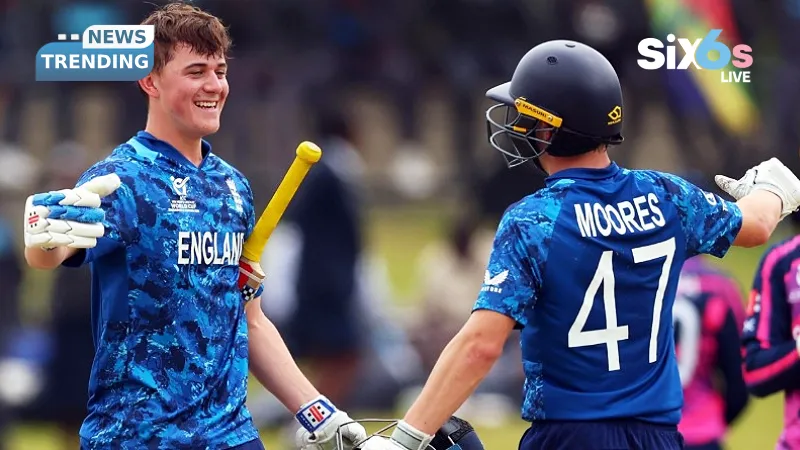
Junior World Cups are for potential; they’re to give you an idea of what’s coming next, rather than to write new records in permanent marker. In one afternoon, however, Ben Mayes rewrote history with Scotland by turning England’s Under-19 World Cup Campaign into a one-man show of courage, of being in the right place at the right time, and sheer dominance.
When rebuilding became irrelevant
When England lost Ben Dawkins early, this is the kind of moment that is typically described as a reason for teams to “consolidate” in coaching literature. However, Mayes didn’t read from that script. From the first delivery, his intentions were evident with what would be punished, length would be dismantled, and anything pitched beyond his comfort zone would be escorted over the ropes. This was not simply reckless hitting it was aggressive hitting based upon balance and shot selection.
In youth cricket, where many bowlers rely upon discipline rather than deception, Mayes turned the tables on Scotland by ensuring they could not establish themselves in defensive positions, so the game never slowed down and became a safe and deliberate accumulation. In short, the message was loud and clear: you don’t have to survive if you can create momentum.
A partnership tilted heavily one way
The 188-run stand against Joe Moores took place in around 22 overs. However, this was the last time anything would be symmetrical regarding the stand. Mayes controlled both the tempo of the batting and the strike rate, while Moores did exactly what you want your number two batsman to do – provide the perfect support for the number three.
This was never going to be a partnership of equals; it was always going to be a well-planned takeover. What impressed me most about Mayes was how quickly he could accelerate his scoring without getting into chaos. He wasn’t targeting one bowler, nor was he focusing on one area of the field; he was disassembling their plans as they were being created. That’s a quality that is normally associated with an experienced player reading fields, anticipating changes, and striking when the opposition is still trying to contain him. To see that quality in an 18-year-old is the bigger story.
Power hitting with historical weight
Eighteen fours and eight sixes tell one tale, while the context tells another. The 191 from Mayes is now tied as the second-highest score in U-19 World Cup history, equal to Hasitha Boyagoda’s total and only trailing Viran Chamuditha’s world record set earlier in this year’s competition. This is what makes his 191 important.
In general terms, historically, the U-19 World Cup has served as a springboard for the next wave of career players whose careers are based on temperament rather than excessive hitting. However, Ben Mayes’ performance falls into the current mold; the best juniors aren’t waiting for their time to hit, they’re dominating all levels of cricket. The 404/6 that England scored wasn’t just a high number; it sent a message that their next group of talented young cricketers is at home with how the game will be played in the years ahead.
What this innings really signals
The large score made in difficult circumstances will likely raise some eyebrows about how easy the opposition was. And why not? It would be crazy not to question it. However, labeling this as simply an issue of being overmatched by lesser opponents misses the larger picture. The defining feature of top-class batsmen at all levels of cricket is not just scoring runs, but also turning potential advantage into a certainty. Mayes was able to do that.
Young English batsmen have often demonstrated good technical skills as young players. Then, when they are older (and presumably better), they can struggle to increase their pace to match that required for the highest level of competition. Mayes’ innings suggests a potentially very different path, one based on intent, flexibility, and a lack of willingness to slow down to protect the traditional methods of play. If this is the model that will guide the development of young players in the England U19 squad, then it could mark the beginning of the alignment of England’s youth program to meet the needs of the modern international game.
Stay updated on the latest cricket news and exciting updates at Six6slive. Dive into our in-depth articles and analyses to connect with the action today!