
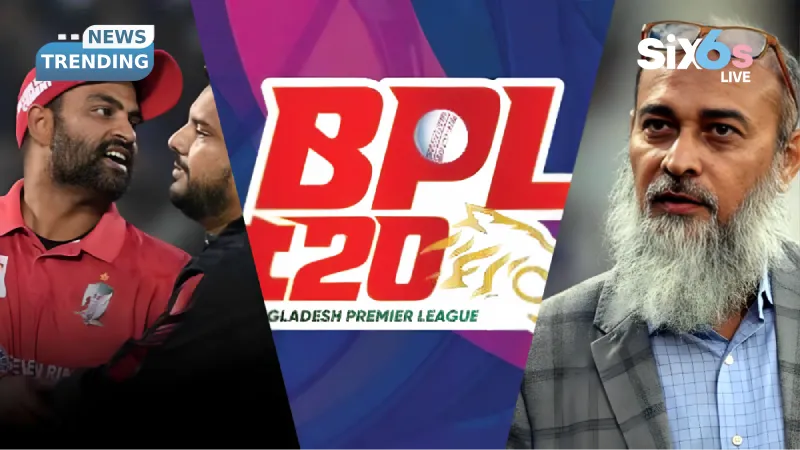
There is usually never a lack of drama with Bangladeshi cricket, but what transpired in the last week felt like something new, less about a dropped catch or a bad read on the pitch, and more about respect, how things are governed, and whose influence is real in today’s world of sports. The Bangladesh Cricket Board (BCB) dismissal of Najmul Islam from his role as Finance Committee chairman on January 15 was far more than just a shake-up at the BCB; it was a reaction to the first time in history that the Cricketer Welfare Association (CWAB) collectively stood up for themselves. The CWAB threatened a boycott of the Bangladesh Premier League (BPL) until Najmul Islam was dismissed due to his having insulted many current and former cricketers and the former captain Tamim Iqbal.
This impasse was both immediate and expensive: the opening game for the Bangladesh Premier League (BPL) on Wednesday between Noakhali Express and the Chattogram Royals had to be rescheduled from the scheduled time of play at the Sher-E-Bangla Stadium. The BCB invoked Article 31 of the BCB Constitution within hours of the announcement of the postponement, naming Aminul Islam as interim Finance Director, and indicated that player dignity was at risk, and with it, the integrity of the season schedule. This is an example of a governance crisis that led to a reckoning in a competition where schedules are limited, and reputations are fragile.
When Players Pull the Emergency Brake
The CWAB President, Mohammed Mithun, made an unmistakable statement when he said the players will not go onto the pitch unless Najmul Islam leaves his current role. This was not simply an act of defiance; this was an action that could be taken in order for the players to play in the league. Participation is the final lever that professionals use to achieve their goals in professional sports. The fact that a single BPL game was canceled shows how quickly a dispute between two parties can jeopardize both the broadcaster’s obligations, the sponsors’ image, and the integrity of competition. Historically, governing bodies rely on central authority in order to ensure consistency; here, the players turned that model upside down by making the results of a governance decision dependent upon whether or not they would play.
also read:- Who Bears the Responsibility if Bangladesh withdraws: The Host Board or the Global Body
Respect as a Non-Negotiable Currency
Mithun’s repeated references to “honor and dignity” were far from being empty rhetoric. Mithun referenced Islam’s comments as an example of “no respect for cricket”, thus raising this conflict from a matter of personal disagreement to a matter of institutional values. The CWAB first attempted to resolve the matter internally by way of closed-door discussions; when those efforts failed, it turned to a public ultimatum. That order of events is significant. It reflects a developing professional practice in international cricket: internal remediation before public escalation, and using the latter only after the former has been fully utilized.
The Board’s Legal Lever—and Its Optics
BCB’s announcement was direct: the President used his powers provided in Article 31 of the BCB Constitution to remove Islam from his duties as a member of the Finance Committee, effective immediately, and assumed the position of Finance Committee chairperson until further notice; that is, when Aminul Islam became the chairman of the board, thus finalizing the shift. It was significant that at this point the BCB did not determine Islam’s position as a director, only that he be removed as a member of the finance committee; the BCB characterized the action as a safeguard to operations rather than a disciplinary decision; restore functionality first, determine whether Islam violated bylaws later.
Stay updated on the latest cricket news and exciting updates at Six6slive. Dive into our in-depth articles and analyses to connect with the action today!