
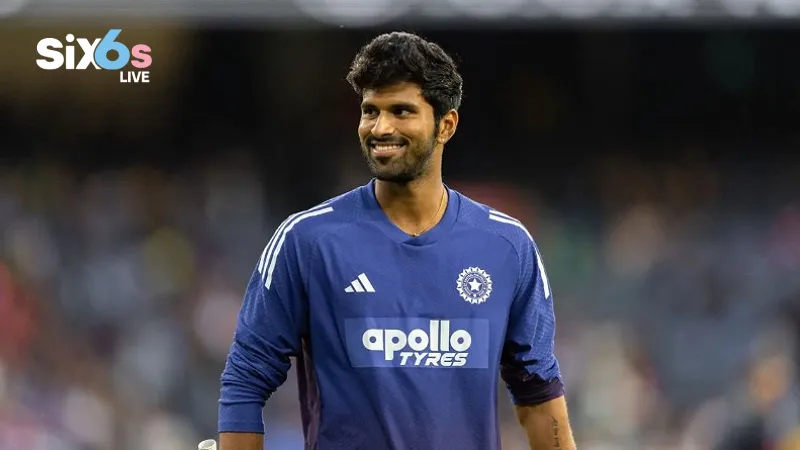
Injuries seldom come to Indian cricket gently; they can arrive at the door of the balance of the team and raise an unsettling question. The sudden departure of Washington Sundar from the current One Day International (ODI) series against New Zealand will likely be remembered as a relatively small incident that has significant implications. The reason for his early exit was a lower rib injury he sustained when bowling in Vadodara. The BCCI’s medical staff is now awaiting the results of further scanning and has requested a specialist opinion regarding Washington Sundar’s condition.
The All-Rounder India Can’t Easily Replace
Sundar isn’t an attention-grabber like others in this team. However, he is a luxury that offers India the best of both worlds – flexibility and control with the ability to use him as an all-round power play spinner and a number eight batsman. Sundar’s economy rates are generally one of the lowest rates of all Indian spinners to bowl early in T20Is and T20 matches. Additionally, his batting has allowed teams to safely add another position to the lineup at the end of the order (No. 8) when playing in a tournament format.
In the world of T20 cricket, it is often the matchup that ultimately determines the outcome of a game. Against left-handed opening combinations, captains can be confident that Sundar will have the skills to attack rather than merely defend. With Sundar out of the side, India is losing an additional option on how to approach a particular situation in the game, and that is not simply losing a player.
Ayush Badoni’s Call-Up: Opportunity, Not Insurance
India has called up 24-year-old Ayush Badoni to replace Sundar in the remainder of the ODIs; the batting prospect is interesting, he is compact, inventive, and fearless with spin, but the swap is stylistically based, not comparable in terms of what each player offers the team. The loss of Sundar as a bowler will shift India’s overall balance.
In ODIs, that could work. Ravindra Jadeja can provide the anchor for the all-rounders, and there are enough bowlers to back him up with Siraj, Prasidh Krishna, Kuldeep Yadav, and possibly some of the new talent, such as Harshit Rana, on the Indian side. In Twenty 20 cricket, though, where each over needs to double as something else (i.e., both bowled and batting), Badoni is a prospect for the long term, but not a current tactical substitute.
A Fragile Build-Up: Tilak Varma’s Absence Compounds the Issue
Sundar is, however, one of many questions surrounding this team. Another player who could add some flexibility in the middle order has been injured and will miss the first three matches against New Zealand. That is Tilak Varma. He can soak up pressure and then quickly speed up as an added option for India’s middle order, a very unusual combination of skills seen in historical Indian T20 lineups that have traditionally had much fireworks coming from their top-order batters.
These absences, collectively, show a recurring problem that India has struggled with for ten years: India has an abundance of specialists, but India does not have enough multi-skilled players capable of participating in a world tournament. The contrast is ironic. India will be hosting the World Cup. India has resources (depth, data) and home-field advantage, yet India can’t make do without its most versatile players.
The bigger issue in India, as they prepare to play their second ODI in Rajkot on January 14 and the three T20Is that follow, is not about who will replace Sundar on the roster; it’s about how well India can strike a balance of players needed to be competitive in today’s T20 format. Versatility is no longer an option, but an insurance policy, as many tournaments are won based on a single run or one matchup. Right now, India’s approach looks much thinner than they are comfortable with.
Stay updated on the latest cricket news and exciting updates at Six6slive. Dive into our in-depth articles and analyses to connect with the action today!