
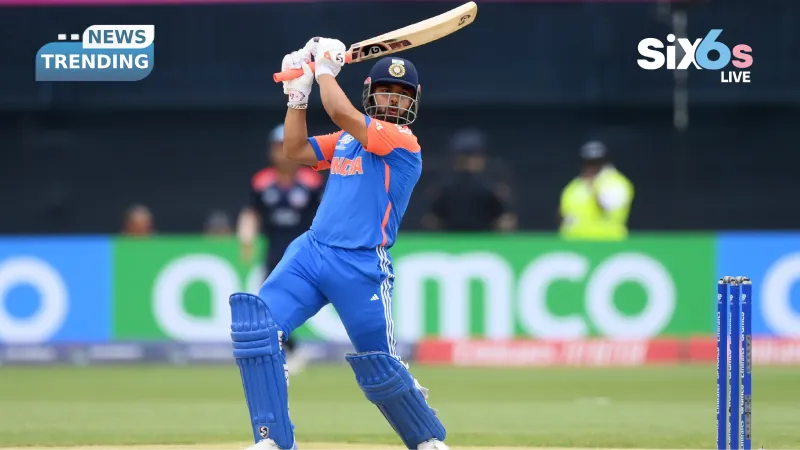
A rather ironic aspect of Rishabh Pant’s absence from play is that while India now has their healthiest squad in some time, they appear to be less unpredictable at present. An unfortunate, freakish oblique strain Pant sustained during a net session in Vadodara forced him to miss the first three games in the three-game ODI series against New Zealand; a non-glamorous but no less damaging injury.
It is not just a matter of replacing a player with another player (in this case, Dhruv Jurel) or having two keepers who can bat (KL Rahul); it is a subtle but significant change in how India thinks about batting, its leadership structure, and how much they are willing to take on going into a potentially very risky series.
Stability over volatility
While Pant’s ODI statistics do not scream “auto-selection, he has never been about the statistics; one hundred in thirty-one games does not define an ODI legacy, nor do five fifties make him vital to the team. He has always been an impactful player based on situation rather than statistics; he can be destructive to bowling strategies, especially spin-heavy teams, as he creates scoring opportunities that most of the other Indian players rarely create.
On the other hand, KL Rahul has demonstrated to be reliable; his ODI batting average, his role within the team, and his ability to manage pressure throughout an innings make him the more predictable, safe batter-wicketkeeper option. In opting for consistency over disruption, with New Zealand having four very disciplined bowling options, India is indicating their desire to build an innings versus create an explosive innings through improvisation.
Middle-order hierarchy clarified
Shreyas Iyer’s quiet return from injury also resolves the problem of selecting more than one player for a particular position. At number four or five, Iyer provides structural balance; as an accumulator who is highly intent on scoring runs off quick bowlers, he is also an experienced player of spin bowling and has been a successful ODI cricketer.
The removal of Pant from the team removes the desire to experiment with different batting orders to try and find a combination that includes both left and right-handed batsmen, as well as “an x-factor.” The batting order can therefore be read with much more logical structure: top order players who provide stability, a stable middle order, and finishers who are clearly defined. In short, there will be fewer experimentation options and fewer pieces of equipment.
Leadership lines drawn
More than just how well they bat, the dynamics of this team tell a larger story. Shubman Gill is the leader, and Shreyas Iyer has been the deputy captain, while Rahul remains the senior on-field tactician and was even captain for India when Gill was out against South Africa.
With Pant’s injury, there is no redistribution of power. Rather, there is an establishment of a unified command structure that can prevent or reduce the number of decision-making mishaps and spontaneous, emotional decisions from being made by the players on the field, as New Zealand is known to exploit such indecision.
What Dhruv Jurel actually represents
Jurel does not replace Pant as a similar player. The same can be said of the other players who were included with him for this reason alone. Unlike Pant, he is tidy, technical, and has an orthodox temperament; whereas Pant makes bowlers uneasy, Jurel provides his teammates with stability. Rather than trying to replicate the effect Pant has on the team, Jurel will help India’s XI to avoid additional instability by providing structure.
India has chosen to stick with an ordered approach over one of imagination; a hierarchical structure that does not lend itself to the experiment of creativity; and a safe, structured tactical approach over chaotic creation. The outline of this team has been conservative by choice and not default, as evidenced by the selection of Rahul as wicket-keeper and batter; the reinstatement of Iyer into the middle order; and Gill at the helm of a top-tier, and thus far, untroubled unit.
Stay updated on the latest cricket news and exciting updates at Six6slive. Dive into our in-depth articles and analyses to connect with the action today!