
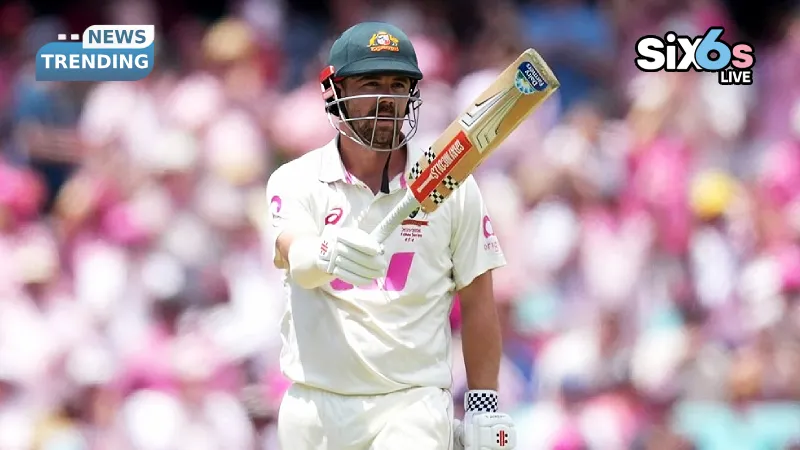
Travis Head had been a luxury item for years for Australia: fashionable, aggressive, and expensive, but never a necessity. Within a batting line-up of metronomes, including Marnus Labuschagne and Steve Smith, Head would be the spark plug rather than the motor. However, the 2025-26 Ashes has quietly inverted this order. Following England’s posting 384 in Sydney, Head’s dominant 163 helped turn Australia’s response into a position of strength 518/7 at the close of play on day 3, and the psychological advantage returned to Australia. The statistics speak for themselves: Head has scored 600 runs from nine innings at an average of 66.67, with a 3-1 lead for Australia in the series, and sits atop the World Test Championship ladder with six wins from seven Tests. It is the role, not merely the Travis Head’s volume of scoring, which has altered. He is no longer the middle order momentum man, but the top order pace setter, an identity he freely admits he did not anticipate wearing.
When the supporting act takes center stage
The change is evident in Head’s own words. He has always been “fortunate to bat around” the heavy hitters, Labuschagne, Smith, and, before them, David Warner. In this Ashes series, he will be doing the heavy lifting himself. Three hundred plus scores in nine innings are not just a purple patch; they are a structural component of the Australian batting unit. Historically, Australia’s batting model has relied on accumulating runs early on, with batsmen gradually increasing their level of aggression as the game unfolds. Head has flipped that rhythm on its head: delivering decisive stroke play while still providing volume of runs. The Sydney century of 163 was not just aggressive counter-punching; it was an extended attack that once again put the pressure back onto the scoreboard for England, following their 384.
The Perth promotion that changed everything
Not in Sydney, however, in Perth did the turning point of the series occur for the Australians when they promoted Travis Head to open. This was a gamble asking a naturally aggressive left-handed batsman to face the new ball, but it was also sensible. Head immediately vindicated this decision by making a match-winning century, which transformed the top order into a batting unit intent on scoring aggressively instead of merely surviving. As such, since then, the results he has achieved have not simply been excellent. They have been pivotal to winning the series. Additionally, the promotion forced England’s bowlers to adjust their strategy. Fields that had previously expected to be able to contain the Australian top order now had to defend, and the probing lengths that were designed to test the batsmen’s techniques were quickly rewarded.
Aggression with structure, not impulse
It is Head’s method as much as the recent performance that sets him apart from previous streaks of scoring. He has scored quickly but, by no means, frantically; he has asserted himself as a batsman without taking undue risks and thereby creating unnecessary chances for the opposing team. This approach to batting, therefore, explains both his average of 66.67 over the course of nine innings, rather than an immediate spike in average followed by a decline and why his innings have come at times when they are most likely to have a significant impact on the game.
Historically, Australia has thrived when there was one player who disrupted conventional ways of scoring, think of David Warner in his early days opening the batting, or Adam Gilchrist coming into bat at number seven with the intention of disrupting the orthodox way of scoring. Head now appears to be assuming this disruptor’s role, albeit in a significantly more vulnerable batting position, and, based on his recent performances, he appears to be relishing the opportunity to do so.
Stay updated on the latest cricket news and exciting updates at Six6slive. Dive into our in-depth articles and analyses to connect with the action today!