
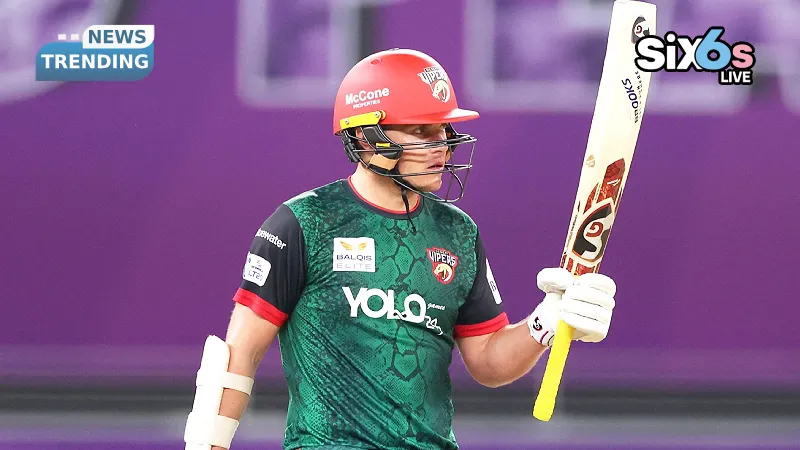
There is an awful memory of Finals. The ILT20 Summit has been a constant reminder to the Desert Vipers that while consistency is important, it is not as valuable as achieving success. It has now happened in the finals twice, with almost two successes and a feeling that something was always missing from their performances when it mattered most. That all changed in Dubai in 2026, and one captain chose to take the calm road rather than the chaotic route.
When Early Aggression Met Sudden Reality
The Desert Vipers’ beginning looked like a recipe for disaster. Fakhar Zaman was seen hitting Shakib Al Hasan’s first ball of the match for a six, and Jason Roy smashed an early boundary, so it seemed like the power play would be a massive hit. However, T20I is known for its quick punishment of impatient teams. Just 2 balls into the game, Fazalhaq Farooqi completely turned the momentum around for his team with 2 dismissals (Roy flat-batted one back to short mid-wicket, and Fakhar fell to a swinging ball which hit him in front of stumps). The momentum of the game completely flipped within 2 balls.
The Vipers were neither flying high nor sinking fast when they were at 59 for 2 after 6 overs. What mattered most, however, was that they still had Curran in the middle of the order – and that he still had plenty of batting to do.
Curran’s Innings Were About Control, Not Noise
In a T20 final, it was only a matter of time before Curran made it to 1, but at 5 deliveries, he seemed to be taking forever. However, as the deliveries passed, it was clear that this delay was due to Curran’s intentions (to play himself in) rather than being nervous. This is evident from the way he rotated the strike; kept to the lower risk areas of the ground, and looked for value on anything that was marginally outside of plan. The pull shot down the leg side, Sam Curran guiding the ball past third man, and picking when to be aggressive all contributed to a very successful innings.
Max Holden’s 41 off 32 for him, as well as his combination with Curran, really put pressure on MI Emirates and kept the run-rate at or above a rate of 8 runs per over when he launched a big shot off the bat against Tajinder Singh. The 89-run third-wicket partnership, although good, was not just about dominating the opposition, but rather it was about denying MI Emirates their wickets, their ability to control the game, and denying them the opportunity to have phases they could dictate.
Desert Vipers had been on the brink of being at the top of the mountain for many years; however, this year, they were able to climb the mountain with a clear sense of direction (intent), with great patience, and with the ability to ruthlessly pursue their goals. Teams that know who they are will ultimately find themselves winning Championships. The Desert Vipers have finally figured out who they are, and that has brought them the trophy.
Stay updated on the latest cricket news and exciting updates at Six6slive. Dive into our in-depth articles and analyses to connect with the action today!